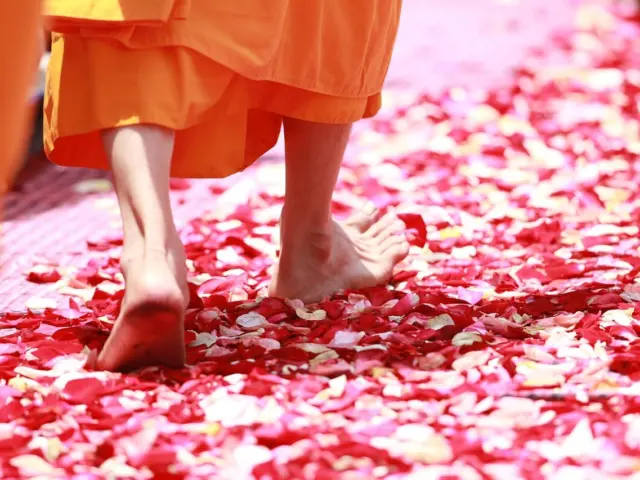

Your calendar is full and a long retreat isn’t happening. Mindful walking at work can fit into a short break: slow down, feel your feet, and let your attention return to each step.
This guide is part of our wider look at mindful walking, applied to the office day.
| Item | Value |
|---|---|
| Lunch-break study: walk length | 15-minute slow stroll in a park |
| Lunch-break study: duration | Every workday for two weeks |
| Lunch-break study: result | Lower end-of-day stress and fatigue, better concentration than on regular-lunch days |
| Suggested walking path | Two points about 20-30 feet apart |
| Longer practice paces | Roughly 10-15 minutes per stage |
The figures come from Mindful’s report on a lunch-break study and Lion’s Roar’s walking meditation guide. They can change, so check the sources before you rely on them.
Why mindful walking at work suits a busy day
Most of us treat breaks as scrolling time. A deliberate walk gives your eyes, body and mind a different task for a few minutes, which is a very different thing from filling the gap with a screen.
One study reported by Mindful asked workers in demanding fields to take a slow stroll or do mindful relaxation at lunch. The walkers and the relaxers both showed significant decreases in end-of-day stress and fatigue, with better concentration, compared with days of regular lunch breaks.
That is one study, and it does not prove a walk will fix a hard week. It does suggest that a planned, unhurried break is worth trying.
What makes a walk mindful
An ordinary walk to a meeting is about getting somewhere. A mindful walk is about being present for the walking itself.
Lion’s Roar describes the idea as letting go of “getting somewhere” and practising walking just to walk. Movement can be a more accessible object of attention than the breath, which helps if sitting still makes you restless.
- Slower pace: a little slower than your normal stride is enough.
- One anchor: choose the soles of your feet, the shift of weight, or your breath.
- Gentle return: when your mind drifts, notice it and come back without scolding yourself.
- No destination: the route matters less than the attention you bring to it.
If you want the formal version, our page on walking meditation goes deeper.
A simple office routine in five steps
You do not need special space. A corridor, a car park edge, a quiet stairwell landing or a nearby sidewalk will do.
- Pause at your desk and put your phone out of reach or on silent.
- Stand, take a slow breath, and feel your weight on both feet.
- Start walking a little more slowly than usual. Feel each foot lift, move and land.
- Stay with one anchor, such as the soles of your feet.
- When you notice you are planning your afternoon, label it “thinking” and return to your steps.
Lion’s Roar notes that, as with sitting meditation, the mind wanders many times. That is not a failure: noticing is the practice.

Working with a busy mind
Work thoughts will follow you down the corridor. Deadlines, unanswered messages and unfinished conversations are all likely to appear as soon as you slow down.
You do not need to push them away. Treat them like passing traffic: acknowledge each one, then return to your feet. The return is the exercise, and it may get easier with repetition.
- Feel the heel touch, the foot roll, and the toes leave the ground.
- Notice the temperature of the air on your skin.
- Listen to the sounds around you without naming them.
- Let your arms hang loose and relaxed.
If you feel impatient, that is useful information too. Notice the impatience as a sensation in the body, and keep walking.
Choosing a path and a pace
Lion’s Roar suggests walking back and forth between two points about 20-30 feet apart. Turning around at each end can help you let go of the urge to arrive somewhere.
Indoors, a hallway works well. Outdoors, a short loop around a courtyard or building does the same job.
For longer practice, the same guide describes staged pacing: a first part, perhaps 10-15 minutes, a little slower than normal, then a second part of similar length slower still. It also says it is fine to choose one pace and keep it.
- On a tight break, keep one pace and a short path.
- On a lunch hour, you can try the staged approach.
- When you cannot slow down, walk at normal pace and keep the attention on your feet; Lion’s Roar says that is acceptable in one version of the practice.
Making it stick on busy days
The hardest part is remembering. Tie the walk to something that already happens, such as the end of a call, the moment the kettle boils or the walk from the lift to your desk.
Start small. A few mindful minutes you actually do beat a long session you skip.
- Set a calendar reminder at the same time each day.
- Use a meeting-free gap, even a short one.
- Invite a colleague for a silent walk if you like company.
- Keep your usual shoes; no gear is needed.
If you are curious how this compares with the cushion, read our piece on walking meditation vs sitting meditation.
Small adjustments for different workplaces
Every workplace offers different space. A few small changes let you adapt the routine without drawing attention or needing a quiet room.
- Open-plan office: use a corridor or the edge of the floor, and keep your steps soft and unhurried.
- Remote work: walk the length of a room at home, or step outside after a video call ends.
- On your feet all day: pause and feel the contact of your shoes on the ground instead of adding extra walking.
- Shared sites: a quiet stretch of outdoor path or a stairwell landing can serve as your two points.
Think of the walk as a short reset between tasks. Many people find it easiest to use the same route each time, because familiar ground lets attention rest on the body instead of on navigation.
Afterwards, take a moment before you sit down. Notice how your body feels and what your mind is doing, then return to work with that awareness rather than rushing straight back to the screen.
When a walk is not the right fit
Some days you have pain, limited mobility, or nowhere safe to walk. You can pause and notice physical sensations in a comfortable position, including while seated.
Mindful practice is not a replacement for medical or mental health care. If work stress feels unmanageable, speak with a qualified professional.
The study above also compared the walk with mindful relaxation, and both helped. If walking does not appeal today, a few minutes of breathing is a reasonable alternative.
Frequently asked questions
How long should a mindful walk at work be?
Show answer
The lunch-break study used a 15-minute stroll, but there is no fixed rule. Begin with whatever your day allows and build from there.
Do I need to walk outdoors?
Show answer
No. Lion’s Roar describes walking back and forth between two points about 20-30 feet apart, which a hallway can provide.
What if my mind keeps wandering?
Show answer
That is normal. Each time you notice and return to your steps, you are practising the skill itself.
Will it reduce my stress?
Show answer
In the study Mindful reported, participants showed significant decreases in end-of-day stress and fatigue. Results for you may differ, and one study is not a guarantee.