Want to guide yourself, or someone else, through a slow walk? This walking meditation script gives you plain words to read aloud or record, plus tips for pacing, pausing and ending.
It sits within our wider guide to mindful walking.
| Item | Value |
|---|---|
| Suggested practice time | 10 minutes daily for at least a week |
| Path length (Greater Good guide) | 10-15 paces, or around 20-40 feet |
| Path length (Kripalu guide) | As short as 20 steps or as long as 30 feet |
| Core idea (Contemplative Mind) | Move mindfully; slowness is not the point |
Figures come from Greater Good in Action and Kripalu. They can change, so check the sources before you rely on them.
How to prepare before you read or record
Choose a short path where you can walk back and forth without being disturbed. The Greater Good guide suggests a route of “10-15 paces, or around 20-40 feet”, while Kripalu describes a path “as short as 20 steps or as long as 30 feet”.
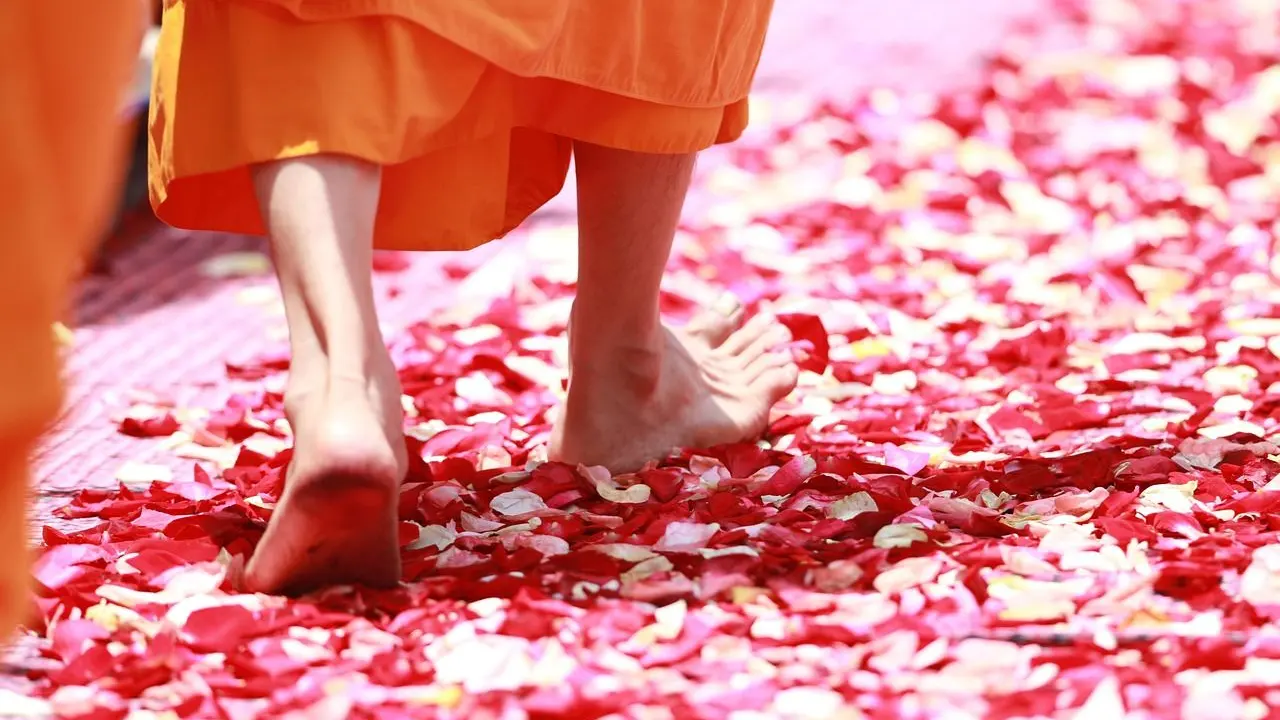
Kripalu also suggests practising indoors, so you are not distracted by your surroundings or by how others might react to a very slow pace. Barefoot or in socks, the small movements of the feet are easier to feel.
- Pick a quiet stretch of floor or garden path.
- Set a gentle timer if you like. The Greater Good guide suggests 10 minutes daily for at least a week.
- If you are recording, speak slowly and leave long silences.
The walking meditation script
Read each line, then pause for a few breaths before the next. Pauses matter more than words, so do not rush them.
Arriving
“Stand at the start of your path. Let your arms hang loosely. Feel your feet on the ground, the weight of your body resting through them. Take a slow breath in, and let it go.”
Starting to walk
“When you are ready, lift a foot. Notice the lifting. Swing it forward, and place it down. Feel the heel, then the ball of the foot, then the toes. Now the other foot. Lift, move, place.”
Following the sensations
“Let your attention rest on the feet and legs. Notice the shifting of weight from side to side. If you like, silently say ‘lifting, placing’ with each step. Let your eyes rest softly on the ground ahead.”
When the mind wanders
“Thoughts will come. That is normal. Notice where your mind went, without scolding yourself, and come back to the feel of the foot touching the ground.”
Turning
“At the end of the path, stop. Feel your breath. Turn slowly, noticing each small movement, and pause again before you set off.”
Closing
“Gradually let your pace slow. Come to a stop. Feel both feet on the ground, and your whole body standing here. Take a last full breath, and when you are ready, carry this awareness into whatever comes next.”
Reading the script to a group or a friend
If you are guiding other people, tell them the plan before you start. Explain where the path begins and ends, that they can stop whenever they like, and that nobody is being graded on how well they concentrate.
Walk the path yourself first so you know how long the silences need to be. Then read slowly, and match your own pace to what you are asking of them.
- Offer a seat for anyone who would rather practise sitting and listening.
- Invite people to keep their eyes open and soft, not closed.
- Leave a quiet pause at the end before anyone speaks.
Afterwards, you might invite people to share what they noticed, but make that optional. Some will prefer to keep the experience to themselves.
Recording tips for a calm voice
Use a steady, unhurried tone, and leave real gaps between lines. Many people find it easier to follow a recording if the silences are longer than feels natural while speaking.
- Record in a quiet room and read from a printed copy.
- Test the recording while walking, since you may need longer pauses.
- Keep the wording simple and repeat key phrases such as “lift, move, place”.
Choosing what to focus on
The feet are the usual anchor, but they are not the only one. The Greater Good guide lists several options, including “your breath coming in and out of your body”, the movement of your feet, legs and arms, and the contact of your body with the ground or floor.
It also mentions sounds nearby and head balance on the neck and shoulders. It also offers wheeling yourself along the path; to adapt this script, replace the standing and stepping instructions with suitable movement and sensation cues. If you record a version for someone else, swap “feet” for “the contact of the chair with the floor” or another sensation that fits.
A simple way to vary the script is to change a single line at a time:
- Breath version: “Notice the breath as you move. Let it find its own rhythm.”
- Sound version: “Let sounds come and go, near and far, without naming them.”
- Body version: “Feel your arms swinging, your shoulders loose, your head balanced and easy.”
Ending the practice and carrying it on
Finish with a pause rather than a sudden stop. Stand still, feel your feet, and notice how your body and mind feel now compared with when you began.
The Greater Good guide also notes you can bring mindfulness to movement at any speed in everyday life. A short reminder phrase from the script, such as “lift, move, place”, can help you carry the practice into an ordinary walk to the shops or the bus.
Try a repeated routine and see whether it suits you. Return to the same script at the same time each day, and adjust the wording until it feels like your own.
Adjusting pace and style
Slow walking is a common choice, but not a rule. The Center for Contemplative Mind in Society says, “The idea is not to walk slowly; the idea is to move mindfully.” That means a script can be adapted to an ordinary pace on a street or trail.
Kripalu, by contrast, says the slowness of your pace helps refine concentration and lets you feel more subtle sensations. Try both and see which suits you.
If you are using the script when you feel unsettled, see our notes on mindful walking for anxiety. For other short practices, browse these mindful walking exercises.
Frequently asked questions
How long should a walking meditation last?
Show answer
The Greater Good in Action guide lists 10 minutes daily for at least a week as the time required. Shorter sessions are fine while you are learning.
Do I have to walk slowly?
Show answer
Not necessarily. The Center for Contemplative Mind in Society says the aim is to move mindfully rather than slowly, though slow walking can make subtle sensations easier to notice.
What if my mind keeps wandering?
Show answer
That is expected. Notice it, then return to the sensation of your feet touching the ground, as the script suggests.
Can I use the script outdoors?
Show answer
Yes, though Kripalu recommends indoors for fewer distractions. Outdoors, choose a quiet, safe spot and keep an eye on your surroundings.