
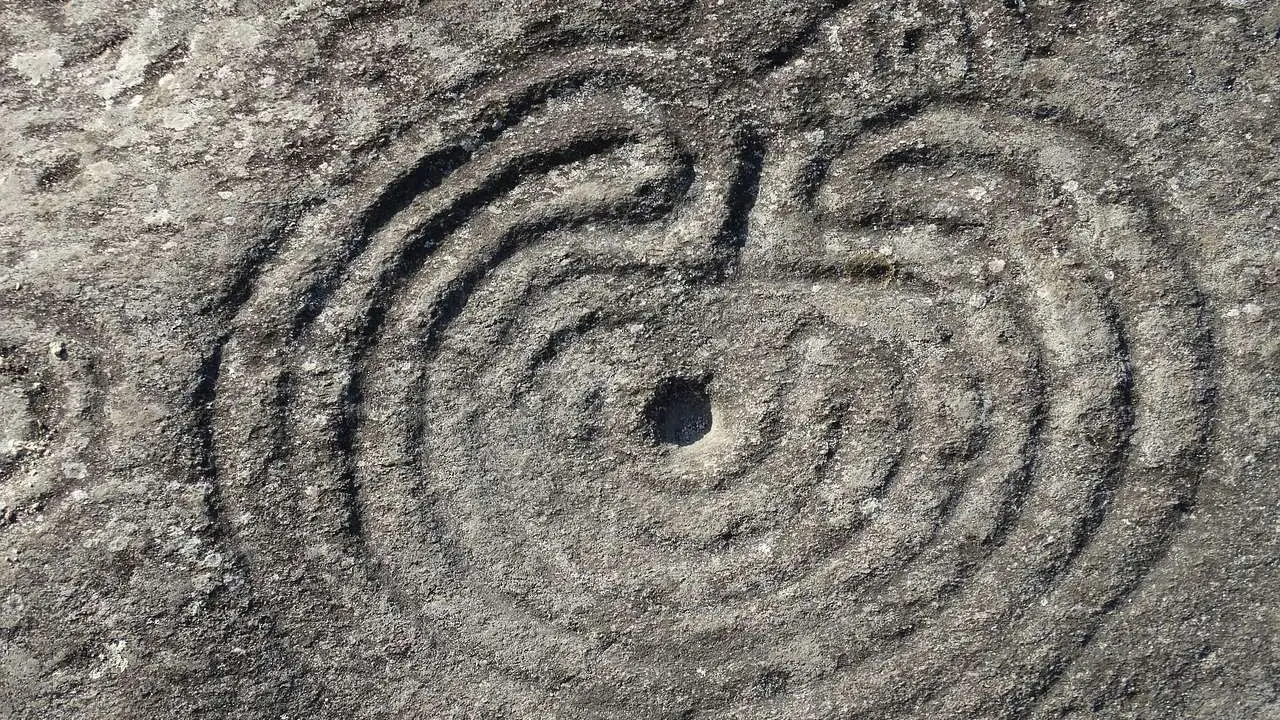
Wondering where labyrinths came from? The history of labyrinths runs from a Greek myth and ancient coins to a medieval cathedral floor, and the story changed a lot along the way.
This guide sits within our wider look at labyrinth design, and follows how the form changed over time.
| Item | Value |
|---|---|
| First Knossos coins with a labyrinth pattern | Around 470 BC |
| Pliny the Elder’s labyrinths in his Natural History | Four buildings termed labyrinths |
| Chartres Cathedral labyrinth laid down | c. 1200 |
| Chartres labyrinth diameter and route length | 12.88 metres across, 261.5-metre route |
Figures come from a journal article on Knossian coins and the World History Encyclopedia. Dates and measurements can change as scholars revise them, so check the sources before you rely on them.
Where does the story of the labyrinth begin?
The best-known labyrinth is a myth. Greek tradition says the craftsman Daedalus built it on the orders of King Minos to hold the Minotaur, and that Theseus found his way out with a ball of twine.
The tale is set in the era now known as Minoan, which dates to around 3000-1000 BC. Depictions of a hero dispatching the Minotaur appear on Greek vases dating back to the 6th century BC, so parts of the story were familiar by then, as The Past reports.
For a closer look at the story itself, see our piece on the Minotaur labyrinth myth.
What did ancient writers say about labyrinths?
Ancient authors disagreed about where the first labyrinth stood. Herodotus described an Egyptian building with twelve covered courts, and later writers linked it to the one in Crete, according to FolkloreThursday.
Pliny joined the two together. He said Daedalus took the Egyptian building as his model, though he reproduced only a small part of it.
The Mielczarek article notes that Pliny lists four buildings termed labyrinths in his Natural History. The second, built by Daedalus in Crete, appears on Knossian coins as the symbol of Knossos.
- Herodotus: an Egyptian labyrinth with many courts and rooms.
- Apollodorus: a Cretan labyrinth built by Daedalus, with tangled windings.
- Pliny: the Egyptian building as the model for the Cretan one.
How did the labyrinth look on ancient coins?
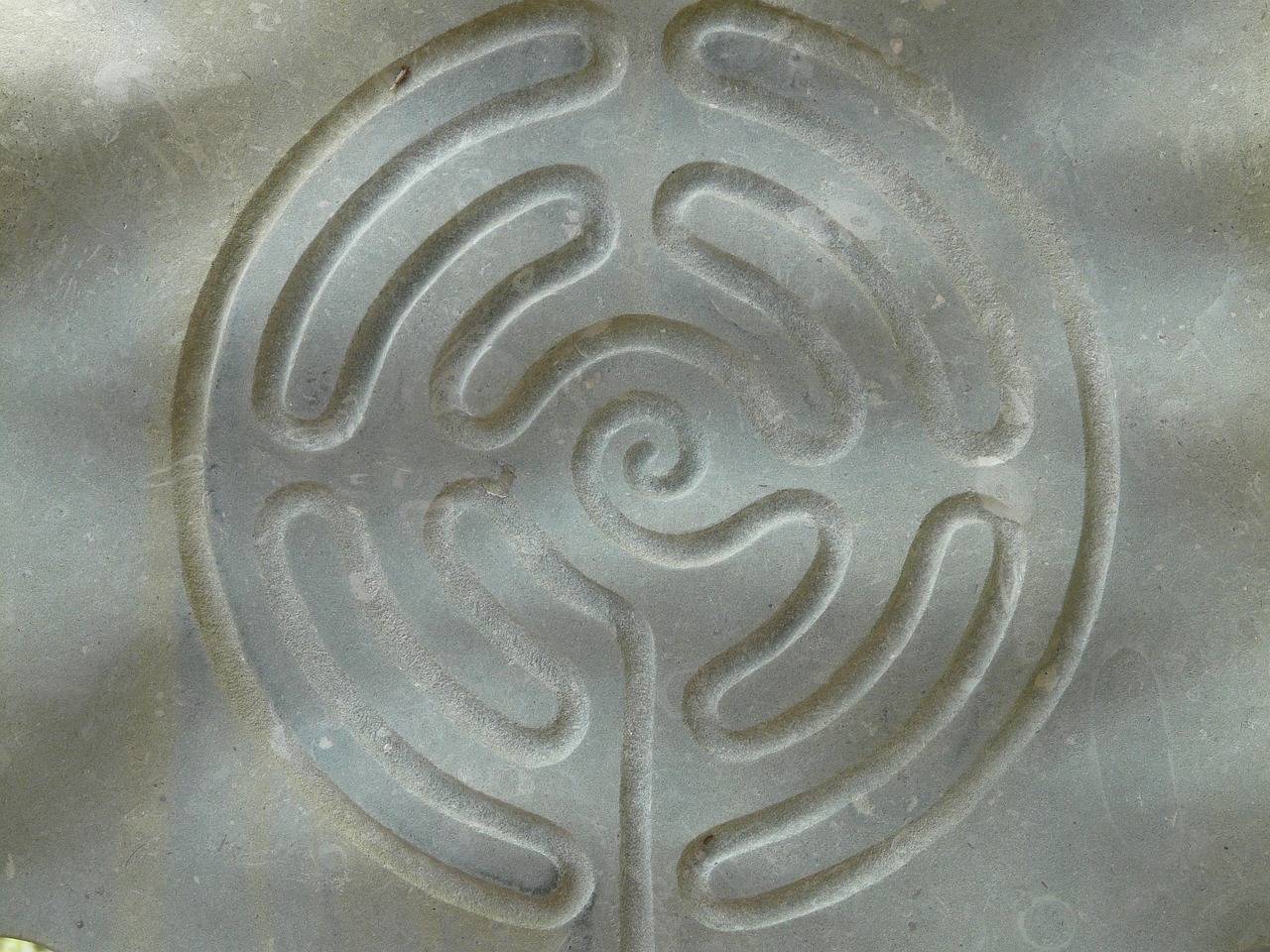
The coins of Knossos give us the clearest early images. The first coins appeared around 470 BC and bore a pattern of four meanders to indicate a labyrinth.
A square labyrinth pattern followed, and this was finally replaced by one of circular form. Dating varies by source: The Past says the design adorned coins minted from 425 BC, so treat the exact years with care.
The shift from four meanders to a square and then a round form shows that the image was never fixed. Die engravers reworked it over time, and each version still read as “the labyrinth” to the people who handled the coins.
The pattern was also popular far from Crete. A graffito at Pompeii in this style carries a Latin inscription that reads ‘here lives the Minotaur’.
Did archaeologists find the real labyrinth at Knossos?
People have searched for a physical labyrinth for centuries. Cristophoro Buondelmonti visited the Labyrinth in Gortyn in 1415, but by the 18th century most travellers agreed it was a Roman quarry.
Knossos came into focus later. A local businessman, Minos Kalokairinos, unearthed a great storage magazine in the 1870s, and Arthur Evans visited the site in 1894.
Evans wrote in his diary that he saw no reason for not thinking that the mysterious complication of passages was the labyrinth. He used his family wealth to buy the site and began excavations in 1900.
Politics slowed the early work. Crete was still part of the Ottoman Empire, and Kalokairinos was dissuaded from continuing, for fear that any outstanding artefacts would be claimed by the imperial authorities, according to The Past.
Even so, on a sketch map drawn in 1878 he labelled his discovery as the palace of Minos, after the legendary ruler of Knossos at the time of the Minotaur. The name has stuck in the way people talk about the site ever since.
It helps to see how the idea of a “real” labyrinth moved around. Travellers first looked at Gortyn, then the claim faded, and Knossos took its place once excavation exposed a palace with many rooms and passages.
Whether the palace inspired the myth is still debated. The link is a tradition built on Evans’s impression, not a proven fact.
How did labyrinths become a medieval church feature?
Labyrinths later turned up in churches. The central flooring of the nave at Chartres Cathedral is paved with a labyrinth design of white stone and black marble, laid down c. 1200, according to the World History Encyclopedia.
The same source says such floor labyrinths were a feature of many medieval churches, though this example is the best preserved in France. Our page on the Chartres labyrinth covers it in more depth.
The design is 12.88 metres in diameter. The World History Encyclopedia interprets the 261.5-metre route as a symbolic pilgrimage or passage through life.
The World History Encyclopedia also points out an odd match. The labyrinth of the nave is almost exactly the same diameter as the west rose window, which also carries a theme of passage to the next life.
The authors read this as a possible spiritual and visual link between floor and window. It is a suggestion about design intent, not a documented medieval statement.
That reading is an interpretation. Some visitors prefer to see the path simply as a quiet walk, and the sources do not settle one meaning.
What can you take from this history today?
The labyrinth has never had one fixed meaning. Each age has read the same winding path in its own way, from a royal prison in Greek story to a devotional route in a medieval nave.
That flexibility is a large part of why the pattern survives. A single circuit can be a puzzle, a symbol, a pilgrimage or a quiet walk, depending on who is standing at the entrance.
The form has been reused for many reasons. It served as a city emblem on coins, a mythic puzzle, a pilgrim’s path and now a tool for slow, mindful walking.
- Treat early dates as approximate, since sources differ.
- Separate the myth from what excavation shows.
- Remember that meanings given to medieval labyrinths are interpretations.
Frequently asked questions
When did labyrinths first appear on coins?
Show answer
The first coins of Knossos appeared around 470 BC, according to Mielczarek’s article. Other sources give somewhat later dates.
Who dug at Knossos first?
Show answer
Minos Kalokairinos unearthed a storage magazine in the 1870s. Arthur Evans began his own excavations in 1900.
Was the labyrinth at Knossos real?
Show answer
Evans linked the palace’s confusing passages to the myth during his visit in 1894. Whether the palace inspired the story remains a matter of interpretation.
What is the Chartres labyrinth used for?
Show answer
The World History Encyclopedia says the faithful walked its route, in imitation of pilgrims who travelled to Jerusalem or as a symbolic passage through life itself.