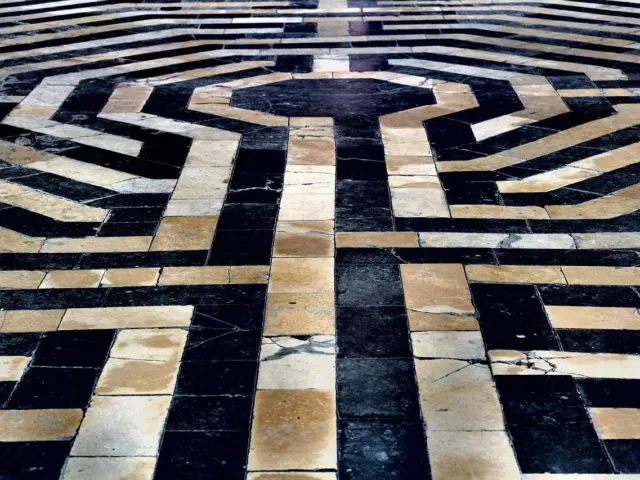

Planning a path to walk and wondering where to begin? Good labyrinth design starts with one choice: how many circuits, and how the single path folds back on itself. This guide explains the patterns, proportions and principles behind that choice.
| Item | Value |
|---|---|
| Chartres labyrinth width | Almost thirteen metres across |
| Chartres circuits | Eleven concentric rings |
| Earliest datable classical motif | 1200 BC |
| Knossos coins showing the design | Minted from 425 BC |
Figures come from a study of the Chartres geometry and a feature on Knossos. Measurements and dates can change as research continues, so check the sources before you rely on them.
What makes a labyrinth different from a maze
A labyrinth has one path and no dead ends. You enter, follow the route to the centre, and walk back out the same way. A maze, by contrast, is built to make you choose.
That difference shapes every design decision. Because nobody needs to solve anything, the designer’s job is to make the walk feel a certain way: slow, rhythmic and calm. The Past’s feature on Knossos puts it plainly: “These labyrinths, like many others, are not puzzles to be solved.”
If you are new to the topic, the broader page on the labyrinth covers definitions and uses. This page stays with how the shapes are made.
- One route: a single path, so no navigation is needed.
- One centre: every pattern has a goal to walk toward and away from.
- One entrance: the way in is also the way out.
The classical pattern and its seed
The oldest and simplest family is the classical labyrinth. Its familiar form has seven circuits, and it appears across many cultures and centuries. The Past reports that its earliest datable appearance “stretches back to 1200 BC, when it was doodled on the back of a tablet inscribed with text known as Linear B at Pylos, Greece.”
The same feature notes that the design adorned coins minted from 425 BC at Knossos on Crete. At Pompeii, a graffito in this style carries a Latin inscription: “here lives the Minotaur”. That link to legend is explored in the Minotaur labyrinth myth page.
Part of the pattern’s long life comes from how easy it is to remember. The Labyrinth Typology project explains that “The use of seed patterns enabled the wide dissemination of the earliest Classical labyrinths, and they are still effective now thousands of years later.”
How a seed pattern works
A seed pattern is a small diagram of the turns along the main axis. Draw the seed, then add curved or squared lines around it, and the full labyrinth grows from those few marks. The typology project notes that for simple labyrinths, “the main axis seed pattern represents the entire pattern.”
The same source lists three style choices for the seed: a cross seed with squared turns only, a hybrid seed with squared and rounded turns, and a diamond seed with rounded turns only. The path is identical in each. Only the look changes.
If you want to try it yourself, the step-by-step guide on how to draw a labyrinth walks through the seed on paper. The page on the seven circuit labyrinth covers that specific pattern in more depth.

Why the path folds the way it does
Look at any classical labyrinth and you will notice the route never takes the shortest way to the centre. It swings to the outside, doubles back, and visits each ring in an order that feels almost random but is not.
The typology research describes this as a question of circuit order. Rather than testing thousands of arrangements, the researchers note that seed patterns and half seeds “allow us to reduce the options to a more manageable number of possibly viable types.” They report that “there are only 14 possible 7-circuit half seeds,” which gives 196 combinations and 42 viable types.
In plain terms, very few orderings of seven rings produce a single unbroken path. The classical pattern is one of those rare solutions, which is part of why it has lasted.
- Alternating directions: the path turns one way, then the other, so you rarely walk the same direction for long.
- Near-and-far rhythm: The classical path visits the outer circuits before reaching the innermost circuit, then moves outward again before entering the centre.
- Even ring spacing: even spacing gives the paths a consistent width; outer circuits are longer than inner ones.
Chartres and the medieval design
The best-known medieval pattern is the one laid into the floor of Chartres Cathedral in France. A study of its geometry says the labyrinth “measures almost thirteen meters across,” and that “The Chartres path passes through eleven circles.”
The same study describes the plan as “The eleven concentric rings split into four parts, the centre with its six petals, and the surrounding ‘cogs’.” It also notes that the labyrinth’s diameter is one tenth of the internal length of the cathedral, from the western doors to the eastern chapel. The full story sits on the Chartres labyrinth page.
Unlike the classical form, the Chartres layout divides the path into quarters, with the walker crossing the centre line several times. The route enters, reaches the middle only after passing through every ring, and ends in a six-petalled rosette.
The design was copied widely. Christ Church Cathedral in Ottawa describes its own labyrinth as a replica of the “13th century eleven-circuit labyrinth at Notre Dame Cathedral in Chartres, France, the first of many installed in French Cathedrals built during the Middle Ages.” For the wider picture of such floors, see medieval church labyrinths.
Proportion and sacred geometry
Ottawa’s description adds that the pattern uses “the intricate spacial relationships known as sacred geometry, visible in the balance between line and path widths, centre and perimeter diameters and the lunations of the scalloped outer corona.”
The idea is that every part is sized in relation to the others. The Chartres study says that at the centre, “the diameter of the petals including the bands around them is the same as the distance from their centres to the middle of the labyrinth.”
Scholars disagree about what the numbers mean. The study itself reviews several theories for why the path has eleven rings and concludes that “None of these seem meaningful enough to have fostered the repetition of the elevenringed design in so many places.” Treat symbolic readings as interpretation, not settled fact.
Reading a pattern before you walk it
Every labyrinth tells you something about its design before you take a step. The entrance, the number of rings and the shape of the centre all hint at how the walk will unfold.
Start with the entrance. In a classical pattern the path leads you straight toward the middle, then swings you out to the edge. In the Chartres plan, the Creation of Gothic study notes that “one enters on the left of the centre-line, and passes straight into the fifth ring; and exits into the centre from the seventh.” That single detail explains why the medieval walk feels so different from the classical one.
Next, count the rings. Circuit count, overall dimensions, centre size and line widths together determine walking distance and lane width. Then look at the centre, which in the medieval form is a rosette and in the classical form is a simple open goal.
- Entrance: where the path begins and which direction the pattern faces.
- Rings: how many lanes the path must fit into.
- Turns: squared, rounded or mixed, as in the cross, hybrid and diamond seeds.
- Centre: an open space or a shaped rosette.
Learning to read these four features makes it much easier to compare patterns and choose one that suits your site.
Common design choices and trade-offs
Every designer faces trade-offs, and none of them has one right answer. The useful habit is to name the trade-off and decide on purpose.
The first is simplicity against richness. A classical labyrinth can be learned in minutes and redrawn from memory, which is why it spread so widely. A medieval pattern can require a more complex layout; its walking distance depends on its size and circuit count.
The second is style against comfort. Squared turns look crisp and architectural, while rounded turns feel softer and are often easier for a walker to follow without hesitating. The typology project treats these as style choices on the same underlying path, so you can pick by taste.
The third is permanence against flexibility. A painted, chalked or mown labyrinth can be adjusted after you have walked it a few times. Mistakes in stone or paving can be costly to correct.
- Choose a classical pattern if space, time or budget is tight.
- Choose a medieval pattern if you have a large, level site and want a longer walk.
- Choose a temporary marking first if you are unsure of the proportions.
Common mistakes to avoid
Most problems in labyrinth design come from rushing the planning. A few errors show up again and again.
- Starting with the pattern instead of the space. Measure the site first, because a pattern that does not fit forces paths too narrow to walk.
- Making the centre too small. The centre is where people pause and turn, so give it room.
- Ignoring the entrance direction. Changing the entrance direction may require rotating the layout and checking its fit on the site.
- Skipping the full-size test. A layout can look right on paper and feel cramped on the ground.
- Treating symbolism as a rule. The Chartres study itself finds no single convincing explanation for its ring count, so there is no need to force a meaning into your own design.
Fixing these early costs very little. Fixing them after the path is laid can mean starting again.
Proportions you can plan with
You do not need to copy a cathedral to use proportion well. Three relationships matter most when you plan a walking labyrinth of any size.
- Path width against wall width. Wide paths with thin lines feel open. Narrow paths with heavy lines feel enclosed.
- Centre size against overall size. A generous centre gives room to pause and turn. A tiny centre feels like a stop sign.
- Entrance placement. Decide which direction the entrance faces before you lay out anything else, because the seed is oriented around it.
Change one of these and the others shift. A designer usually fixes the available space first, then chooses the circuit count that gives a comfortable path width inside it.
More circuits mean a longer walk but narrower paths in a given footprint. Fewer circuits give wider paths and a shorter, simpler walk. In a small garden, a classical pattern often fits better than a medieval one for exactly this reason.

Designing for the walker
A labyrinth is only useful if people can walk it. Path width is the first practical test, and it matters most when wheelchairs or walkers might use the route.
Florida State University’s labyrinth, for instance, “was designed to comply with the Americans with Disabilities Act including 3-foot walking paths and multiple points along the path with a turning radius to accommodate a wheelchair.” That is one project’s choice rather than a universal rule, so check local requirements for your own site.
Other points deserve thought before you commit to a design:
- Surface: firm, even ground is easier to walk slowly than loose gravel or uneven grass.
- Edges: the lines should be clear enough to follow without staring at your feet.
- Turning space: the tight turns of a seed pattern need room, especially near the centre.
- Passing: two people meet on the same path, so wider routes help.
Because the walk is meant to be slow, the design should support it. The page on mindful walking describes the pace that most designs are made for.
Turning a design into a real labyrinth
Once you have chosen a pattern, the work moves from paper to ground. Start small: a sketch, then a scaled drawing, then a full-size layout marked out with string or chalk before anything permanent goes down.
For materials and sequence, the guide to how to build a labyrinth covers the practical steps. If you are working at home, backyard labyrinth ideas shows how different spaces and budgets change the choices.
- Measure the space and note slopes, trees and edges.
- Pick a pattern that fits: classical for small sites, a larger medieval form where space allows.
- Test the layout at full size with temporary markers.
- Walk it slowly, and adjust width and centre size before making it permanent.
The site on which you build can also guide the pattern. The long record of labyrinths, covered in the history of labyrinths, shows designs scaled for floors, fields, coins and courtyards alike.

Adapting old patterns to new places
Designers have always adapted the patterns they inherited. The seed approach makes this easy, because the underlying path stays the same while the surface changes.
A classical pattern can be drawn with squared lines for a courtyard, with rounded lines for a garden, or as a diamond for a decorative floor. A medieval layout can be scaled down for a small space, though a smaller version means narrower lanes.
When you adapt a design, keep the parts that make the walk work: one continuous path, a clear entrance and a defined centre. Treat the decoration as the flexible part.
- Materials: stone, brick, turf, paint or gravel all carry the same path.
- Scale: shrink or enlarge, but check that the lanes stay walkable.
- Setting: indoors, a garden, a school yard or a campus lawn.
Principles to carry forward
Across thousands of years, a few principles hold. The path is single and continuous. The pattern is simple enough to remember, whether as a seed or as a set of concentric rings. Proportions are balanced so that the walk feels even.
Past those principles, there is plenty of room to choose. Squared or rounded turns, classical or medieval, stone or painted line: each is a legitimate design that suits a different place and walker.
Keep an open mind about symbolism. The shapes carry meaning for many people, but symbolic interpretations should not be treated as settled facts.
Frequently asked questions
What is the simplest labyrinth design to start with?
Show answer
The classical pattern is the usual starting point. It has seven circuits and grows from a small seed pattern, so you can sketch it from memory once you have practised.
How big is the Chartres labyrinth?
Show answer
A study of its geometry says it measures almost thirteen metres across and has eleven concentric rings. The figure is approximate, so check the source for exact measurements.
What is a seed pattern?
Show answer
It is a small diagram of the turns along the main axis. For simple labyrinths, the Labyrinth Typology project says the main-axis seed represents the entire pattern.
How wide should the paths be?
Show answer
It depends on who will walk them. Florida State University’s labyrinth uses 3-foot paths with turning points for wheelchairs, but that is one example, so check local requirements for your site.
Does the number of circuits change the experience?
Show answer
Yes. More circuits give a longer walk but narrower paths in the same space, while fewer circuits give wider paths and a shorter route.