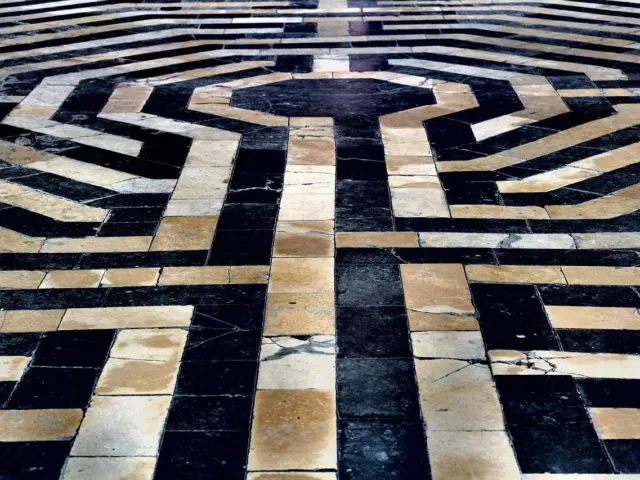

Wondering what a seven circuit labyrinth actually is? It is a single winding path of seven rings that leads to the centre and back out, with no dead ends and no wrong turns.
This guide sits within our wider look at labyrinth design.
| Item | Key fact |
|---|---|
| Number of circuits | 7 rings around the centre |
| Path type | Unicursal: one path, no branching |
| Earliest coin association with the Labyrinth | As early as 430 BC |
| Securely datable examples in India | From around 250 BC |
| Entrance position in the classical pattern | At the bottom |
These figures come from Wikipedia’s Labyrinth article and from Craftwhack’s drawing guide. Dates and scholarly views can change, so check the sources before you rely on them.
What is a seven circuit labyrinth?
A “circuit” is, in one craft guide’s words, “one complete ring of the path around the center, so a 7-circuit labyrinth has seven rings.” The path winds back and forth between those rings before it reaches the middle.
It is often called the Classical or Cretan pattern. The same craft guide describes it as “the classic labyrinth most people picture.”
Smaller and larger versions exist. The same guide teaches a three-circuit design, which it calls the simplest labyrinth, and an eleven-circuit design, which it says is bigger, so you should scale down on regular letter or A4 paper.
Labyrinth or maze?
The two words are often swapped in everyday speech, but many enthusiasts keep them apart. In the specialised usage, a maze is a “complex branching multicursal puzzle with choices of path and direction,” while a unicursal labyrinth has only a single path to the centre.
Craftwhack puts it more plainly: a labyrinth looks like a maze, but it has no dead ends or choices. Wikipedia says a labyrinth in this sense has “an unambiguous route to the center and back” and presents “no navigational challenge.”
That difference shapes the whole experience:
- A maze asks you to solve something.
- A labyrinth asks you only to keep walking.
- The seven-circuit pattern is the best-known version of the second kind.
Where the pattern comes from
The seven-course design is tied to the Greek myth of the Labyrinth. In that story, the structure was designed and built by the artificer Daedalus for King Minos of Crete at Knossos, and its function was to hold the Minotaur, the monster eventually killed by the hero Theseus.
Coins give the clearest early evidence. Wikipedia notes that the single-path seven-course “Classical” design “became associated with the Labyrinth on coins as early as 430 BC.” Early Cretan coins sometimes showed branching patterns too, so the single-path form was not the only image in use.
For India, Wikipedia says securely datable labyrinth examples begin to appear around 250 BC.
Was the Labyrinth really at Knossos?
Arthur Evans, who excavated the Minoan palace of Knossos, suggested that the ruins there inspired the story of the labyrinth. He found bull motifs and depictions of a labrys, a double-bladed axe, carved into the walls.
Not everyone agrees. Oxford geographer Nicholas Howarth believes that “Evans’s hypothesis that the palace of Knossos is also the Labyrinth must be treated sceptically.” His team searched an underground complex known as the Skotino cave and concluded that it was formed naturally.
Another idea rests on a passage in the Iliad. It has been suggested that the palace was the site of a dancing-ground made for Ariadne by Daedalus, where young men and women would dance together.

Beyond Greece: other places the design appears
The pattern turns up well outside the Mediterranean. Wikipedia reports that early labyrinths in India typically follow the Classical pattern or a local variant of it, and that some have been described as plans of forts or cities.
A design “essentially identical” to the 7-course classical pattern also appears in Tohono O’odham culture. It differs in two ways:
- It is radial in design.
- Its entrance is at the top, where classical labyrinths have the entrance at the bottom.
The Romans, meanwhile, created many decorative unicursal designs on walls and floors in tile or mosaic. Unicursal labyrinths also appeared as designs on pottery or basketry, as body art, and in etchings on walls of caves or churches.
Not every ancient “labyrinth” was a path pattern. Herodotus used the word for a building complex in Egypt, which he considered to surpass the pyramids.
How the design works when you walk it
Because there is a single route, the walk needs no navigation. Your attention can rest on your steps, your breath and the turns of the path.
That is why unicursal patterns have been used historically both for group ritual and for private meditation. They are also increasingly found for therapeutic use in hospitals and hospices, according to Wikipedia.
You do not need a large site to try the idea. Craftwhack notes that many people trace the path of a small labyrinth drawing with a finger as a relaxing, mindfulness-style exercise.
For a bigger, permanent version, our backyard labyrinth ideas show how the pattern can be scaled to a garden.
Drawing the seven-circuit pattern
Drawing starts from a seed pattern. For seven circuits, Craftwhack describes starting from “the plus sign, a dot in each corner, and a small ‘L’ shape in each of the four quadrants.”
The steps run in a simple order:
- Mark the plus sign in the centre of your page.
- Add a dot in each corner.
- Draw a small L shape in each of the four quadrants.
- Connect the pieces with curved lines, working outward until the rings close around the centre.
The same method scales from the three-circuit design, which uses a smaller seed. Once you have a clean drawing, you can colour it, doodle on it or cut it out as an art project.
Our step-by-step page on how to draw a labyrinth walks through the full method.
Frequently asked questions
How many rings does a seven circuit labyrinth have?
Show answer
It has seven rings of path around the centre. One craft guide defines a circuit as one complete ring.
Is a seven circuit labyrinth the same as a maze?
Show answer
No. A maze branches and offers choices, while a seven-circuit labyrinth has one path to the centre and back.
How old is the seven-circuit design?
Show answer
Wikipedia dates its association with the Labyrinth on coins to as early as 430 BC.
Where is the entrance?
Show answer
In the classical pattern the entrance is at the bottom. The Tohono O’odham version has it at the top.