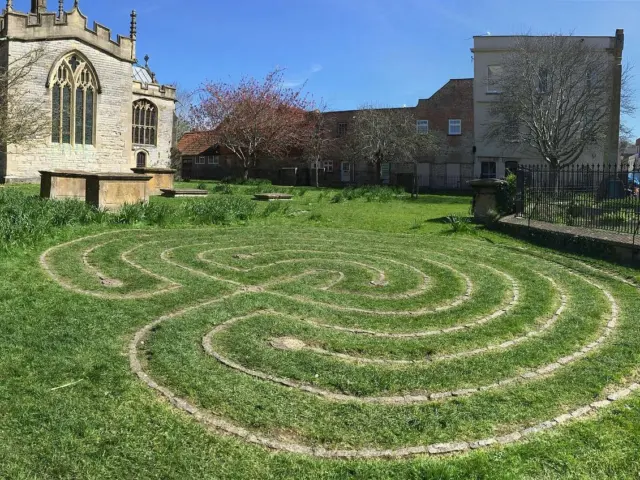

Looking for a finger labyrinth printable you can use tonight? Print any single-path labyrinth pattern, sit somewhere quiet, and trace it slowly with one finger, in to the centre and back out again.
A finger labyrinth is a small, portable version of the full-size labyrinth you can walk on the ground.
| Item | Value |
|---|---|
| Circuits in the Chartres labyrinth | 11 circuits, counted from the outside to the centre |
| Chartres Cathedral floor labyrinth created | Between 1201 and 1220 A.D. |
| Centre design of the Chartres labyrinth | A rosette with 6 petals |
| Participants in a 2023 World Labyrinth Day study | 461 people from 19 countries |
These figures come from a Wizzley article on walking and finger labyrinths and a Women’s Brain Health Initiative page on labyrinth walking. They can change or be corrected, so check the sources before you rely on them.
What a finger labyrinth is, and why print one
A finger labyrinth is a labyrinth pattern small enough to trace with a fingertip. Finger labyrinths have the traditional patterns traced out on plastic, pewter, wood or paper, so a printed sheet is a low-cost way to start.
One of the advantages is that it is portable. You can carry it with you, keep it in an online file, and use it at any time.
It is also worth knowing what a labyrinth is not. A labyrinth has a single path from one entrance into the centre and back out again. A maze, by contrast, is built to be hard to get through, so there are no dead ends or choices to make on a labyrinth sheet.
Where to find free patterns to print
Search for a pattern from a labyrinth organisation or an educational publisher rather than a random image site.
Look for these qualities before you print:
- One continuous path with no branches or dead ends.
- Clear, wide lanes that your fingertip can follow without touching the wall lines.
- A defined centre where you can pause.
- Terms of use that allow personal or classroom printing.
Labyrinth societies and educational publishers often offer downloadable designs. Check each site’s terms of use before you copy or share a sheet.
The classic Chartres pattern
One pattern to look for is the Chartres labyrinth. According to the Wizzley article, the eleven-circuit labyrinth was created in stone on the floor of the Chartres Cathedral in France between 1201 and 1220 A.D. Dates for medieval works vary between sources, so treat this range as approximate.
In this design there are 11 circuits, or rings, counted from the outside to the centre. The centre is a rosette with 6 petals.
If you want a gentler first experience, a simpler pattern with fewer circuits is quicker to finish. Choose a classic Chartres sheet when you have time to settle in.

How to use your printed labyrinth
Using a finger labyrinth is simple. The steps below follow the guidance in the Wizzley article, with a few practical additions.
- Find a quiet place where you can sit comfortably, and put the sheet flat on a table.
- Remove any jewellery or watch from the hand you will use to trace.
- Take a few deep breaths before you begin.
- Place a fingertip at the entrance and follow the path slowly, at the pace of your breathing.
- Pause at the centre for as long as you like.
- Trace your way back out along the same path.
Use whichever finger and hand feel natural.
If your mind wanders, simply return to the feeling of the path under your finger. For a fuller guide to the walking practice, see our page on labyrinth meditation, which covers it in more depth.
What the research says about labyrinth walking
The research is mostly about walking a full-size labyrinth, not tracing a printed one. Per the Women’s Brain Health Initiative page, a review by Davis points out that the research to date lacks methodological rigour and focuses mainly on psychological effects. That review concludes that labyrinth walking has mostly positive psychological effects but unclear physiological effects, and calls for more research.
The same page describes a 2023 study published in Frontiers in Psychology. It took place on World Labyrinth Day 2021, during the COVID-19 pandemic, and included 461 participants from 19 countries.
No evidence on this page tests finger labyrinths specifically. Treat a printed labyrinth as a calm, low-cost pause in your day, not as a treatment for any health condition.
Make the practice your own
A printed sheet gives you room to experiment, because you can print as many copies as you like. These are practical suggestions rather than rules, so adjust them freely.
- Set a simple intention. Some people carry a question or a worry in with them and leave it at the centre. Others carry nothing at all and just follow the line.
- Slow down at the turns. Each change of direction is a natural moment to take a breath before you continue.
- Try different sheets. A pattern with wide lanes feels different from a tight one, and a different design can refresh a habit that has gone stale.
- Keep a copy handy. A sheet in a notebook, a desk drawer or a bag lets you pause during a busy day.
- Use a pencil as a stand-in. If your fingertip covers the lines, a blunt pencil end or a closed pen can follow the path instead.
The Women’s Brain Health Initiative page also notes that research points to benefits from a single session of labyrinth walking and suggests there is likely even more benefit to repeated walking. That is about full-size walks, but a short daily tracing session fits the same idea of returning to the practice regularly.
If the experience feels frustrating at first, that is normal. A finger labyrinth asks you to do very little, and noticing how restless your attention is can be the first useful thing you learn from it.
Take it from paper to the ground
Once you enjoy the paper version, you may want to walk a real one. Full-size labyrinths are often found in parks, churches, hospitals and retreat centres. If you live in Canada, our guide to labyrinths in canada is a place to start.
This site is independent and educational. It is not connected to any organisation or product mentioned here, and it does not sell anything or take enquiries.
Frequently asked questions
Is a finger labyrinth the same as a maze?
Show answer
No. A labyrinth has a single path into the centre and back out, while a maze is intentionally challenging and can make you lose your way.
Which hand should I use?
Show answer
Use whichever hand feels comfortable.
Can I use a finger labyrinth on a screen?
Show answer
Yes, if you like. The Wizzley article notes that a finger labyrinth can be kept in an online file, though many people prefer the feel of paper.
Do I need special paper or a printer setting?
Show answer
No. Plain paper works, though a heavier sheet is easier to hold and less likely to wrinkle under your finger. Print at full size so the lanes stay wide enough to follow.
How long should I spend tracing it?
Show answer
There is no set time. Move at the pace of your breathing, pause at the centre, and stop when you feel ready.