Curious about a labyrinth but not sure where to begin? A labyrinth is a single winding path that leads to a centre and back out, with no wrong turns. You simply walk it.
| Item | Value |
|---|---|
| Path type | A single path (unicursal) to the centre and back out again |
| Typical shape | Round, combining a circle with a spiral |
| Tricks or dead ends | None, which separates it from a maze |
| Typical use | Contemplative walking for personal, psychological and spiritual transformation |
| Chartres Cathedral labyrinth | Dates from the early 1200s |
The definitions come from The Labyrinth Society’s media FAQ, and the Chartres detail from American Friends of Chartres. Descriptions and dates can change or vary between sources, so check them before you rely on them.
What is a labyrinth?
A labyrinth is a pattern with one path. According to The Labyrinth Society, it is a design with a single path (unicursal) that leads to the center and back out again. You enter, follow the curves, reach the middle, and return the way you came.
Because there is only one route, you never have to choose. That is the whole point: the pattern makes the decisions, so your mind can rest. The absence of route choices may make the experience feel calm rather than puzzling.
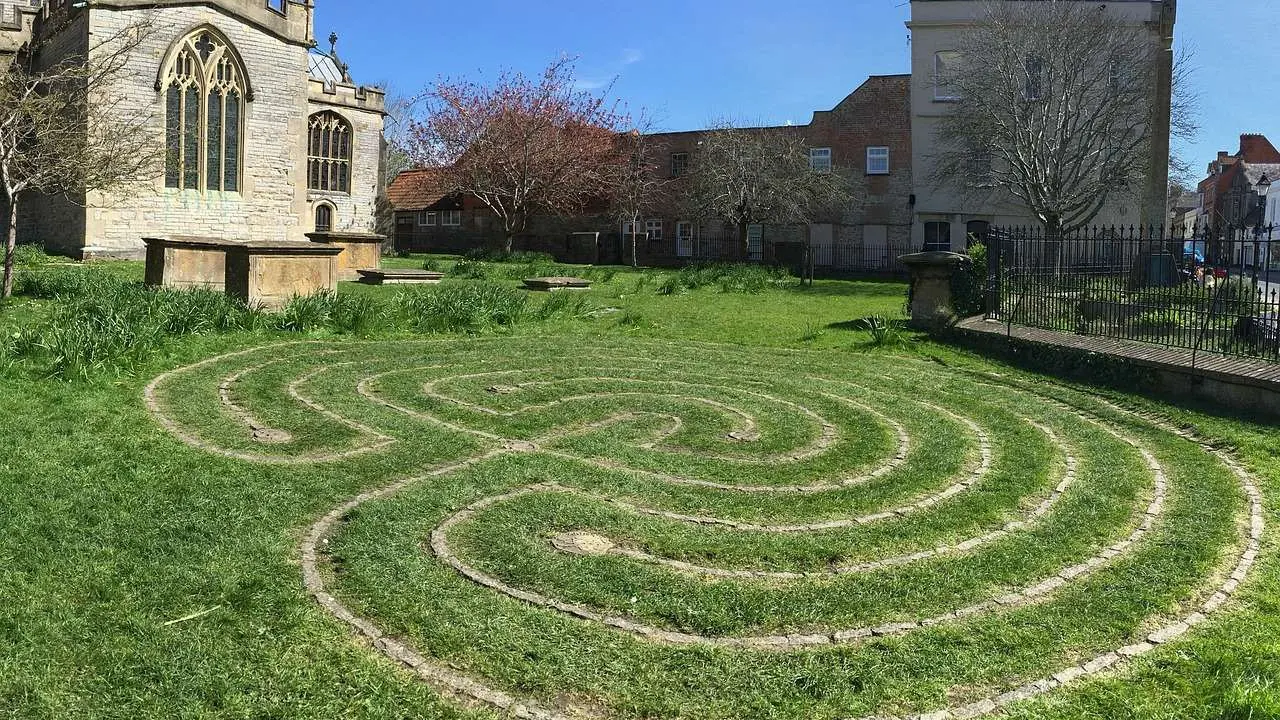
The same society notes that labyrinths are typically round and are considered to incorporate a circle with a spiral. Not every labyrinth is a circle, though. Square, rectangular and free-form designs exist, and the common thread is the single, unbranching route.
Labyrinths appear in many settings. You may meet one:
- painted or laid in stone on the floor of a church or hall
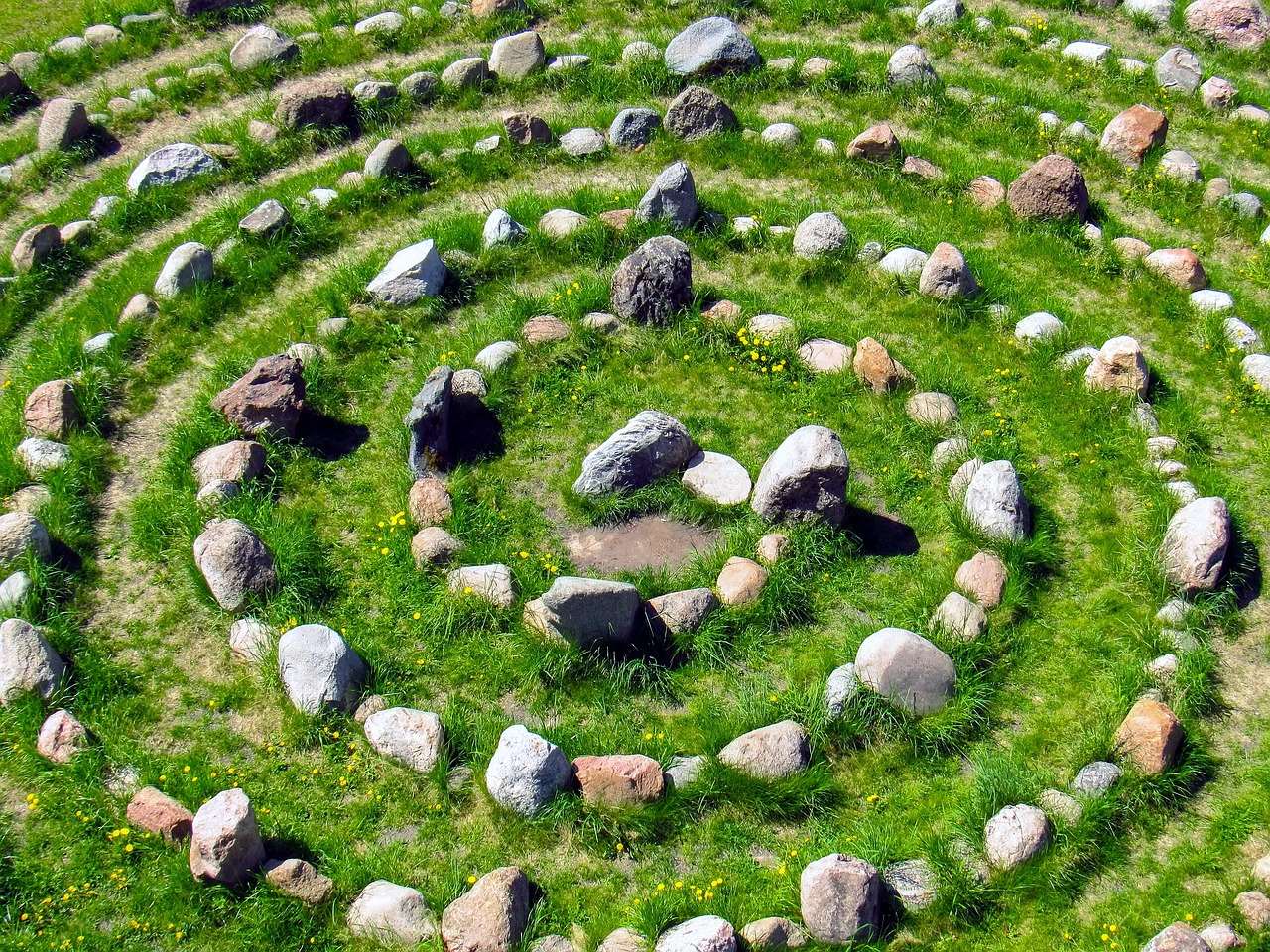
- cut into grass or marked out with stones in a park or garden
- at a hospital, retreat centre, school or community space
- drawn on paper or carved in wood to trace with a finger
If you want the full story behind the word and its symbolism, the guide to labyrinth meaning goes further than this overview.
Labyrinth or maze: what is the difference?
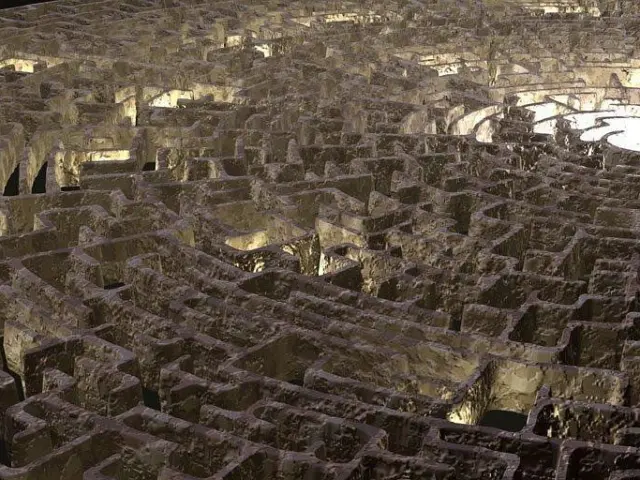
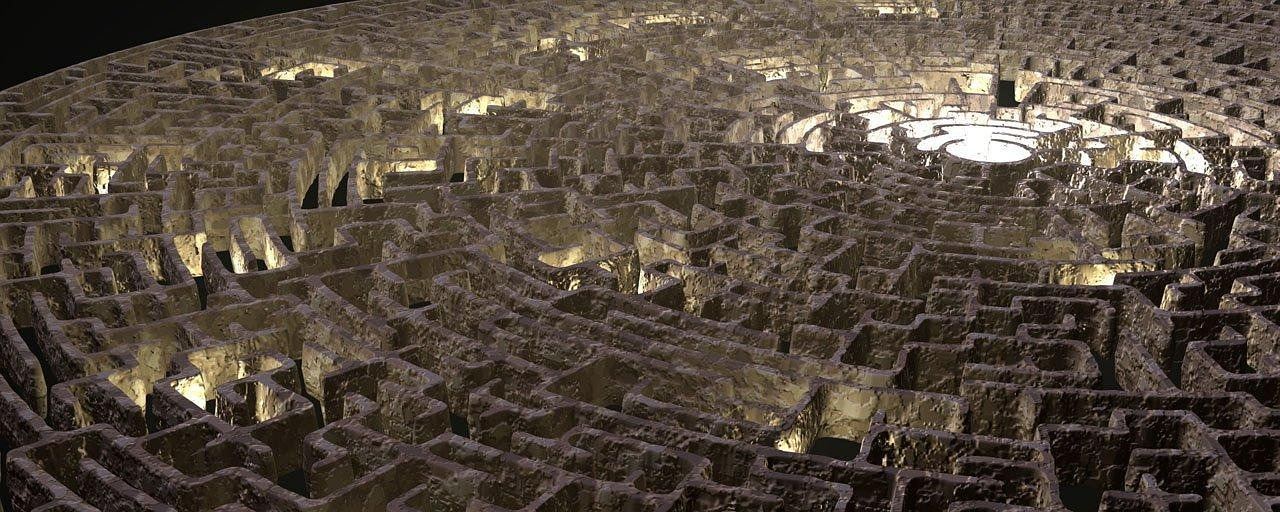
The two words are often used as if they were the same, but the designs work differently. A maze is built to confuse. A labyrinth is built to be followed.
The Labyrinth Society says the terms are sometimes used interchangeably and there are exceptions to the rule. For its purposes it distinguishes the labyrinth as a pattern having a single path (unicursal vs. multicursal) that has no tricks or dead ends.
In practice, this gives you a quick test:
- Maze: branching paths, choices, dead ends, and a puzzle to solve.
- Labyrinth: one path, no choices, and nothing to solve.
Everyday speech blurs the line, and you will see hedge mazes called labyrinths and the reverse. A fuller comparison lives in labyrinth vs maze, which is worth reading if you are choosing which kind of space to visit.

A short history: from ancient designs to Chartres
The labyrinth pattern is old, and medieval churches used it in their floors. The best-known example is still the one at Chartres, which shaped many of the designs you will meet today.
The most famous walking labyrinth is the one in Chartres Cathedral, France. American Friends of Chartres describes the labyrinth as a prominent feature of the nave floor, with a single, unbranching path, unlike mazes which have multiple choices and dead ends.
That description matters for beginners. It shows that a labyrinth has long been understood as a walk with one route and no tricks, a quality that modern community labyrinths still share. Visiting a copy of the Chartres pattern is a good way to feel how the old design works, even if you cannot travel to France.
A study of the design traces how it passes through eleven circles, and notes that it was known as the “Chemin de Jerusalem”, the road to Jerusalem. You can read that source on the Chartres labyrinth paper from the Creation of Gothic project. One college textbook adds that a pilgrim walking the path travels 861.5 feet, making it the largest labyrinth made in the Middle Ages, per its chapter on the cathedral.
Sources vary on exact measurements, so treat any single figure with care. The names it carried point to pilgrimage, with the walk standing in for a journey to a holy place.
The Chartres pattern has been copied widely. American Friends of Chartres notes that replicas exist in other locations, such as Grace Cathedral in San Francisco, and that chairs in the nave at Chartres are removed on specific days so pilgrims can walk the path.
Why the single path matters
The single path is more than a design detail. It shapes how a visitor feels while moving through the space, and it is the reason a labyrinth suits quiet reflection.
In a maze, attention goes to the next decision: left or right, forward or back. In a labyrinth, that job disappears. What is left is the act of walking, the changing direction of the curves, and whatever thoughts come up.
This is also why the labyrinth works as a metaphor. The path to the centre is not a straight line, and the turns can feel like detours, yet they all lead where you are going. Many walkers find that idea comforting when life feels indirect.
Taken together, these ideas explain why the labyrinth has lasted. It asks very little of you: no skill, no equipment, no decisions. It offers a defined place to slow down, and a clear start and finish that give a short walk a sense of shape.
That simplicity also makes it easy to share. A group can walk the same path in turn, each person finding a personal meaning in a common pattern, and nobody needs to explain what they experienced afterwards.
How people use labyrinths today
The Labyrinth Society says labyrinths are generally used as a tool for personal, psychological and spiritual transformation through contemplative walking. That covers a lot of ground, and people bring very different aims to the same path.
Common reasons include:
- slowing down after a hectic day
- sitting with a decision or a loss without forcing an answer
- marking a milestone, a season, or a quiet moment of prayer
- practising attention in a form that is easier than sitting still
The society also states that labyrinths are thought to enhance right brain activity and invite relaxation. Treat that wording as a belief held by walkers and organisers rather than a medical claim. Labyrinth walking is not a treatment, and it does not replace care from a health professional.
If you like the idea of walking as a calm practice more broadly, mindful walking shows how the same attention works on an ordinary path. A labyrinth simply gives that attention a shape and a clear boundary.
Who might enjoy labyrinths
Labyrinths suit a wide range of people, and you do not need a particular belief or temperament to try one. They tend to appeal to a few kinds of visitor.
- Busy people who want a short, structured pause in the day.
- Restless thinkers who find sitting meditation difficult and prefer to move.
- Spiritual seekers from many traditions who value ritual and symbolism.
- Teachers and group leaders looking for a calm shared activity.
- Curious beginners who simply like unusual places and patterns.
If you are dealing with serious distress, a labyrinth can be a gentle companion but it is not a substitute for professional support. Reach out to a doctor or counsellor when you need one.
Your first walk: what to expect
There is no wrong way to walk, and no test to pass. Still, a few simple steps make a first visit smoother. The detailed guide to how to walk a labyrinth covers the finer points.
- Pause at the entrance. Take a breath, and settle on a question or simply on being present.
- Walk at an easy pace. Slower than usual is fine; you can stop whenever you like.
- Notice the turns. The path bends back on itself, and you may feel close to the centre, then farther away. That is normal.
- Rest in the centre. Stay as long as feels right before heading out.
- Walk back out. Return along the same path, and take a moment at the end.
Other walkers may share the path. If you meet someone, step aside or pass quietly; most people simply go around each other with a nod.
Wear comfortable shoes, and check the surface if the labyrinth is outdoors. Many sites are open to anyone, but some are on private or institutional grounds, so look for posted hours or notices.
Etiquette, comfort and access
A labyrinth is usually a shared space, so a little courtesy goes a long way. Silence or soft voices are the norm, and phones are best kept on silent.
Before you go, think about a few practical points:
- Surface: stone, paint, grass and gravel all feel different underfoot, and wet weather changes things.
- Mobility: some paths are narrow or uneven, so ask the host about wheelchair or walker access, or whether a flat paper version is offered.
- Children and pets: rules differ by site, and a quiet explanation helps children enjoy it.
- Photos: ask first, especially in a church or when others are walking.
If walking feels hard for any reason, you can sit at the edge and trace the pattern with your eyes.
Ways to walk: attention, questions and stillness
People approach the path in a few broad ways. None is required, and you can try each on different visits.
- Releasing: on the way in, let thoughts and worries settle.
- Receiving: in the centre, stay open and quiet.
- Returning: on the way out, think about how to carry the calm into daily life.
Some walkers prefer to bring a question, while others bring nothing at all. Both are fine. If your mind races, count your steps or notice your breath, then come back to the path.
The practice is explored in more depth in the guide to labyrinth walking, and the contemplative side is the focus of labyrinth meditation. Those pages are a good next step once your first walk is behind you.
Keep expectations gentle. A walk might feel quietly pleasant, or a little dull, or surprisingly emotional, and all of those are ordinary responses.
Common beginner worries
New walkers often ask the same few things. Here are plain answers.
- “Will I get lost?” No. With a single path, the only way is onward, and you can always turn and walk out.
- “Am I doing it right?” There is no right way, so whatever you do counts as walking it.
- “Do I have to feel something?” No. Some visits feel like nothing special, and that is fine.
- “Is it only for religious people?” No. Labyrinths are used in faith settings and in secular ones such as parks, schools and care settings.
The best advice is to go once with no goal, then decide whether the practice suits you. Many people return to the same path at different times and notice something new.
No labyrinth nearby? Try a finger labyrinth
Not everyone lives near a public path, and not everyone can walk one. Smaller options keep the practice within reach.
You do not need open ground to practise. A finger labyrinth is a small version of the same single-path design that you trace with a fingertip, so it fits on a desk, a lap or a bedside table.
The idea is the same as a full-size walk: enter, reach the centre, and return. Because it is small, it is easy to use for a short break. The page on the finger labyrinth explains how it works.
If you would like to try one at home, the finger labyrinth printable guide helps you find a pattern to print. Trace slowly with your non-dominant hand if you want an extra reason to pay attention.
Looking for a full-size path close to home? The overview of labyrinths in canada is a starting point for finding places to walk.
Making a small habit of it
A practice sticks when it is easy. If you enjoy the first walk, a simple routine can help you return without pressure.
- Pick a place you can reach without effort, such as a nearby park, church or community garden.
- Choose a regular time, perhaps after work or on a weekend morning.
- Walk with no agenda for the first few visits.
- Keep a short note afterwards about how you felt, if writing helps you.
- Use a finger labyrinth on days when you cannot get out.
Over time, you may find you prefer a certain pattern or setting. That is a sign the practice is becoming your own.
Designs and building your own
Many labyrinths follow a small number of classic patterns, and others are new designs. Some have a handful of rings; others, like the medieval Chartres pattern with its eleven circles, are far more intricate. Walk length depends on the overall size and layout, as well as the number of rings.
If you are thinking about making one in a garden or school yard, start by understanding how the pattern is laid out. The guide to labyrinth design covers the basics of layout and path width.
A simple temporary labyrinth can be made with rope, chalk or stones. Check with the landowner first, and think about access for people who use mobility aids.
Think about the purpose before the pattern. A school might want a short, wide path for groups, while a quiet garden might suit a longer, more winding design.
Whatever you build, keep the single-path rule. Once a design adds branches or dead ends, it becomes a maze under this definition. Also plan for upkeep: grass needs mowing, paint fades, and stones shift.
Frequently asked questions
Is a labyrinth the same as a maze?
Show answer
Not in the sense most walkers use. The Labyrinth Society distinguishes a labyrinth as a pattern with a single path that has no tricks or dead ends, while a maze offers choices.
Do I need any experience to walk one?
Show answer
No. There is no correct way to walk. Enter, follow the path to the centre, and return at your own pace.
Is walking a labyrinth a religious activity?
Show answer
It can be, but it does not have to be. The Chartres labyrinth is tied to Christian pilgrimage, yet many people walk labyrinths for calm, reflection or simple curiosity.
What if there is no labyrinth near me?
Show answer
You can trace a finger labyrinth on paper or wood, or look for community, church, park and hospital labyrinths that welcome visitors. Always check access before you go.
How long does a labyrinth walk take?
Show answer
It depends on the size of the labyrinth and how slowly you walk. Small garden paths can be walked in a few minutes, while large floor designs take longer. There is no set time, so go at the pace that feels comfortable and stay in the centre as long as you like.