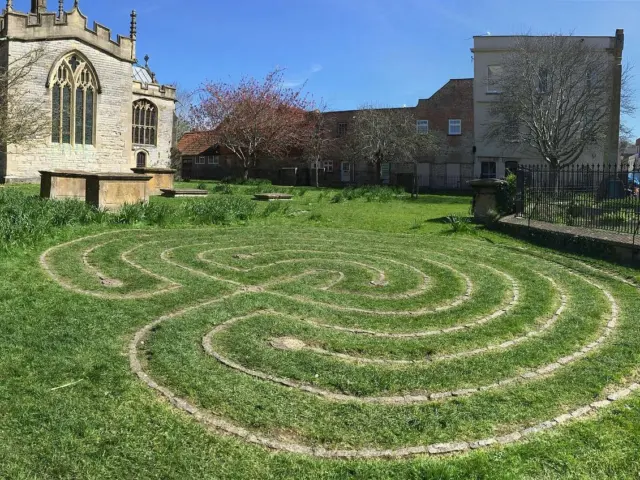

Feeling too busy to sit still? Labyrinth meditation gives your mind a path to follow. Walk it in three stages, trace it with a finger, or carry one simple question inside.
New to the idea? Start with our guide to the labyrinth, then come back here to practise.
| Item | Value |
|---|---|
| Walking stage one | Releasing |
| Walking stage two | Receiving |
| Walking stage three | Returning |
| Finger method starting point | Index finger at the entrance |
| Finger labyrinth settings | Waiting areas, office or home |
Figures come from Central Connecticut State University’s labyrinth page and Healio’s report. Guidance can change, so check the sources before you rely on them.
Why a labyrinth works as a meditation tool
A labyrinth has one path and no dead ends. That means you never have to decide where to turn, so your attention is free to settle on your breath and your steps.
Sitting meditation asks you to hold still while your thoughts run. A labyrinth gives the body a simple job, which many people find easier. If you want the history behind the pattern, our piece on labyrinth meaning explains where it comes from.
The three approaches below suit different moods and spaces. Pick one, try it a few times, and notice what changes.
Approach one: walk the three stages
The best-known framework splits a walk into releasing, receiving and returning. Central Connecticut State University’s meditative labyrinth page describes all three, drawing on a facilitators guide.
- Releasing. On the way in, let go of the day and come into the present moment. The page suggests taking a deep breath, quieting your inner critic and turning off your cell phone.
- Receiving. At the centre, sit or stand for as long as you like. The page says to listen to your inner voice and receive what is there for you.
- Returning. When you are ready, follow the same path back out.
Other sources use different words for the stages, so treat the names as a guide, not a rule. What matters is the shape: a way in, a pause, a way out.
Tips for the walk
- Find your natural pace and stay with one step at a time.
- If your mind wanders, notice it and return to your feet.
- Meet other walkers with a nod, and pass them where the path allows.
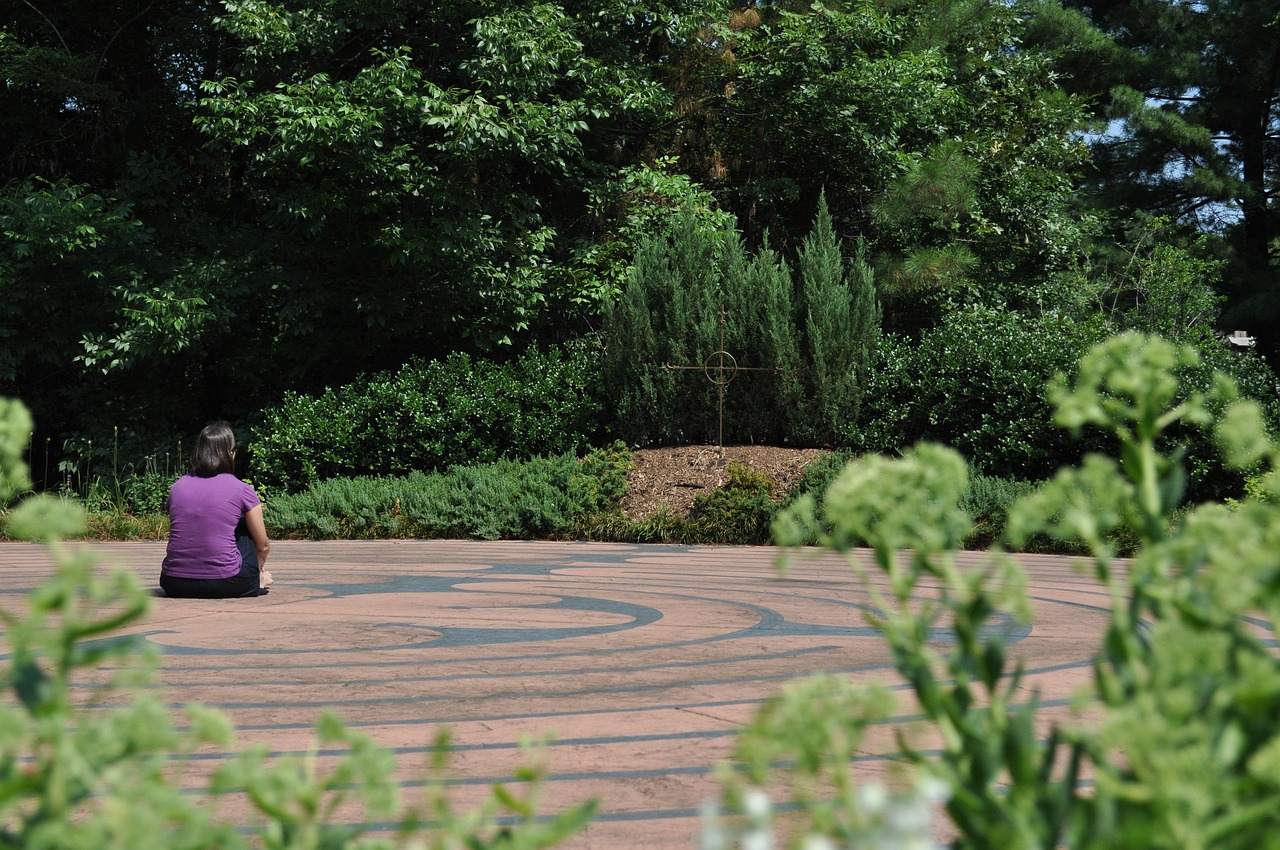
Approach two: trace a finger labyrinth
You do not need a garden or a church floor. Healio’s report says paper and finger labyrinths provide tactile engagement and may be used in meditation, stress reduction and mindfulness practices.
The method is simple. Place your index finger at the entrance and slowly trace the line toward the centre. The report adds that you can follow the path with your finger and trust the journey, both physically and mentally.
The same three stages work here. Breathe naturally as you trace inward, rest your finger at the centre, then trace back out. A finger labyrinth printable is an easy way to start at a desk or kitchen table.
The report notes that tracing a labyrinth with a finger may be a useful stress reduction tool in waiting areas, in the office or at home. That makes it a practical choice for short breaks.
Approach three: walk with one quiet question
This approach is a personal variation on the stages above, not a fixed method from a source. Before you enter, choose a single question or intention. Keep it short and kind, such as “What do I need right now?”
Hold the question lightly on the way in, then let it go. At the centre, wait without forcing an answer. Some people receive a clear thought, and others receive only quiet, and both are fine.
You can use this with a finger labyrinth as well. Write down anything that comes up afterwards, in a few plain words.
Common obstacles and how to meet them
Most beginners hit the same few snags. Knowing them in advance makes them easier to handle.
- Restlessness. Slow your pace by a little, and feel your feet or fingertip touching the surface.
- Self-judgement. There is no wrong way to walk. The CCSU page suggests quieting your inner critic, and that applies to the whole practice.
- Distraction. Thoughts will arrive. Name them quietly, such as “planning” or “worry”, and return to the path.
- Crowding. If others are walking, wait or step aside. Patience is part of the meditation.
Treat each of these as practice material, not as failure. Noticing a wandering mind and coming back is the whole skill.
Notice too that the path keeps turning you in different directions, sometimes close to the centre and sometimes far from it. Many walkers find this a gentle reminder that progress is not always a straight line.
Setting up a practice that lasts
Try a short, regular practice and see whether it suits you. Choose a time you can protect, such as after work or before the house wakes up, and keep the same cue each time.
Begin with a small ritual at the entrance. Pause, take a slow breath, and silence your phone. The CCSU page lists turning off your cell phone as part of releasing, and the same step helps with a finger labyrinth.
A simple routine to try
- Stand or sit at the entrance and take a deep breath.
- Set a loose intention, or none at all.
- Move slowly, taking the path a little at a time.
- Rest at the centre for as long as feels right.
- Retrace the path, and notice how your body feels at the exit.
Afterwards, spend a minute noticing your mood before you reach for your phone. A few written words can show you patterns over weeks, such as which approach calms you most.
Choosing between the three approaches
There is no ranking here. The right choice depends on your space, your energy and how much time you have.
- Walking the stages suits you when you have access to a full-size labyrinth and want movement and fresh air.
- Finger tracing suits you when you are indoors, short on time, or find walking difficult.
- The quiet question suits you when you are facing a decision or a heavy feeling and want to approach it gently.
You can also combine them. Trace a finger labyrinth in the morning to set your tone, then walk a large one at the weekend with a question in mind.
If you are curious about how the practice might feel, try it once without expectations. Use the first walk to get familiar with the turns, without expecting a particular feeling.
What to expect, honestly
Labyrinth walking is a gentle practice, not a treatment. The sources used here describe it as a tool for stress reduction and mindfulness, and they do not promise cures.
If you have a health concern, talk to a qualified professional. This site is an independent educational resource and is not connected to any labyrinth, organisation or product it mentions.
Frequently asked questions
Do I need a large labyrinth to meditate?
Show answer
No. Healio’s report says paper and finger labyrinths can be used in meditation and mindfulness practice, so a small one works.
Which hand should I use on a finger labyrinth?
Show answer
Healio’s report names the index finger. Beyond that, use whichever hand feels comfortable.
How long should a walk take?
Show answer
There is no set time. The Central Connecticut State University page tells you to find your natural pace and stay at the centre as long as you like.
What if my mind keeps wandering?
Show answer
That is normal. Notice the thought, return to the next step or the next inch of the path, and carry on.