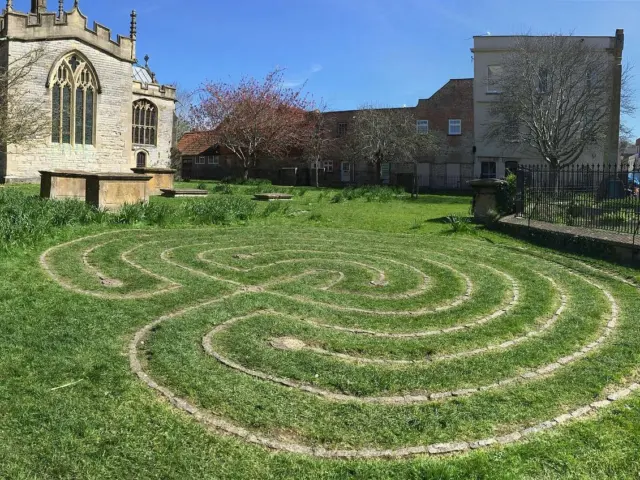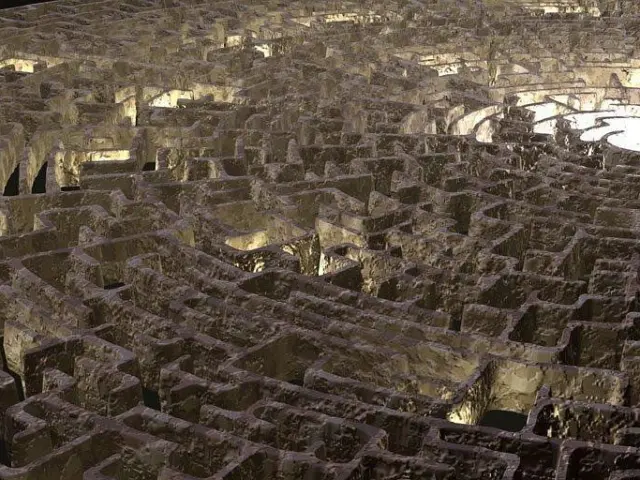

Nervous about your first labyrinth walking experience? Relax: there is one path, no dead ends and no wrong way to do it. You simply walk in, pause at the centre and walk back out.
New to the idea? Our guide to the labyrinth explains the pattern itself, while this page covers the walk.
| Item | Value |
|---|---|
| Number of paths in a labyrinth | One single winding path |
| Dead ends | None |
| Stages of a typical walk | Three: releasing, receiving, returning |
| Route out | The same path; the entrance becomes the exit |
| Labyrinth vs maze | A labyrinth is not a maze |
These points come from Veriditas, “New to the Labyrinth?”. Practices and guidance can change, so check the source before you rely on them.
What labyrinth walking actually is
Labyrinth walking is a slow, walking meditation along a marked path that winds to a centre. Veriditas describes the labyrinth as “a walking meditation, a path of prayer and an archetypal blueprint where psyche meets Spirit.” You do not need to share that spiritual framing to take part, and many people simply treat it as a quiet walk.
The most common surprise is how simple it is. Veriditas says the labyrinth “has only one path that leads from the outer edge in a circuitous way to the center” and that “there are no tricks to it and no dead ends.”
That is the key difference from a maze. A maze asks you to solve something and risk getting lost, while a labyrinth asks you only to keep walking.
The three stages of a walk
Veriditas says “generally there are three stages to the walk: releasing on the way in, receiving in the center and returning when you follow the return path back out of the labyrinth.” These are a framework rather than a rulebook, and you can use them loosely.
- Releasing: On the way in, let your pace settle and notice your breathing. Let thoughts about the day drift past without chasing them.
- Receiving: At the centre, stop for as long as feels right. Stand, sit or simply look around, and stay open to whatever comes up, even if that is nothing.
- Returning: Walk back out along the same path. Think about how you want to carry the quiet back into the rest of your day.
You can also set an intention at the start. The underlying idea is the same, so choose whichever version helps you.

Before you start: simple preparation
You need very little to begin. Comfortable shoes you can walk slowly in are enough, and a few quiet minutes at the entrance help you shift gears.
- Pause at the entrance and take a few slow breaths.
- Decide whether to bring a question or an intention, or none at all.
- Switch your phone to silent and keep it in a pocket.
- Choose a time when the path is likely to be quiet, if you can.
An intention is optional.
What it feels like on the path
Expect the path to curve more than you predict. You will often walk close to the centre and then swing back out toward the edge, which is normal and part of the design. Trying to guess where you are in the pattern tends to pull you out of the walk, so it is easier to let that go.
Your mind will wander, and that is not a failure. When you notice it, bring your attention back to your feet, your breath or the ground in front of you.
Since the path is two-way, you may meet other walkers coming the opposite direction. Walkers usually step around each other quietly, and nobody expects conversation.
Do you have to walk the whole way?
No. Veriditas notes that “you may go directly to the center to sit quietly — whatever meets your needs.” Adjust the walk to your energy, your mobility and your mood on the day.
Because the path is single and the entrance becomes the exit, you can always turn around and retrace your steps. There is nothing to get wrong.
If you cannot get to a labyrinth, a finger labyrinth lets you trace a small pattern with a fingertip instead. If you want somewhere to walk close to home, see our overview of labyrinths in canada.
What to expect afterwards
Veriditas says walking the labyrinth “quiets the mind, opens the heart and grounds the body.” That is the organisation’s own description rather than a guaranteed result, so treat it as a hope and not a promise.
Both are ordinary reactions, and a second or third walk often feels different from the first.
After you finish, sit for a minute before you leave. You might jot down a line or two about what you noticed, or just stand quietly at the exit.
Common first-walk worries
You may worry about doing it badly. Here are some possible concerns, with plain answers.
- “I will feel silly.” Most walkers are focused on their own steps, and a quiet labyrinth is usually a forgiving place.
- “My mind will not stop.” A busy mind is the starting point, not a problem. Return to your breath each time you notice it racing.
- “I do not know what to feel.” You are not meant to feel anything in particular. Some walks are calm, some are dull, and some are emotional.
- “I might get in someone’s way.” Step aside or pass with a small nod. Courtesy is enough.
- “I am not spiritual.” You can treat the walk as slow, deliberate exercise and attention practice.
If a walk stirs up strong emotion, stop, breathe and sit for a while at the centre or the edge. Nothing obliges you to finish, and you can always return another day.
Making the practice your own
After a first walk, small adjustments can change the experience a great deal. Try a different time of day, or walk more slowly than feels natural. You can also carry a single word or question in with you and see whether the centre offers a response.
Others come only when life feels heavy. Either rhythm is fine, because the path asks for nothing except your attention.
Keep your expectations light. Notice how you feel over time, without expecting a particular benefit.
Frequently asked questions
Is a labyrinth the same as a maze?
Show answer
No. Veriditas states that the labyrinth is not a maze: it has a single winding path, so you cannot get lost.
Is there a right way to walk it?
Show answer
There is a common three-stage pattern of releasing, receiving and returning, but you can use it loosely. You can also go straight to the centre if that is what you need.
How do I leave the labyrinth?
Show answer
You retrace your steps to the start, because the entrance doubles as the exit. There is no separate way out to find.
Do I need any beliefs or experience?
Show answer
No special experience is needed. Many people treat the walk as a plain quiet walk, and others bring a spiritual or reflective intention.