
Looking for labyrinths in Canada you can actually walk? Several public ones are listed in a shared worldwide directory, and a few details, such as access, winter use and fees, decide whether a visit works.
This guide is part of our wider look at the labyrinth, its forms and its uses.
| Item | Value |
|---|---|
| Chemainus Labyrinth (British Columbia) type | Medieval 11-circuit, painted concrete |
| Chemainus Labyrinth size | 48 feet diameter |
| Chemainus Labyrinth installed | 15 September, 2017 |
| Crieff Hills Retreat Centre labyrinth built | 2006 |
| Crieff Hills admission | $10/day |
| Crieff Hills labyrinth type | Classical 7-circuit |
These figures come from listings in the Labyrinth Locator entry for Chemainus and the entry for Crieff Hills Retreat Centre. Listings are submitted by site contacts and can change, so check the source and the site itself before you rely on them.
Where to find public labyrinths in Canada
The most useful starting point is the Labyrinth Locator, a worldwide directory with a map and a radius-based search. Each entry shows who looks after the labyrinth, its type, its material and whether it is open to the public.
Entries use a few availability labels. Public indicates public access; check the entry for hours and any advance arrangements. Appointment and private listings require contacting the host.
Canadian listings include parks, churches, retreat centres, farms and community gardens. Because anyone with a site can submit an entry, the directory is a guide rather than a complete census, and some labyrinths may be missing or out of date.

Three listed examples worth knowing
The three below were checked against their directory pages. They show how different a Canadian labyrinth can be.
Chemainus Labyrinth, British Columbia
The listing describes a Medieval 11-circuit design in painted concrete. It says the site is public, outdoor, permanent and wheelchair accessible, with a schedule of “Always Open”.
The same page gives a size of 48 feet diameter and an install date of 15 September, 2017. It credits the Chemainus Festival of Murals Society as the project’s lead, with support from the Chemainus Rotary club and the Municipality of North Cowichan.
Crieff Hills Retreat Centre
This is a Classical 7-circuit labyrinth marked out with rock or garden material. The listing says it was built in 2006 with Presbyterian Canada Youth conference volunteers, using fieldstones from the property.
Access differs from Chemainus. The listing shows admission of $10/day, says it is available all year round depending on snow levels, and marks wheelchair access as “No”.
Canadian Ecology Centre
Here the labyrinth is a Classical 7-circuit in outdoor grass. The listing says it is wheelchair accessible and open 365 days, and it adds that the labyrinth is “great for snowshoeing”.
Reading the differences between sites
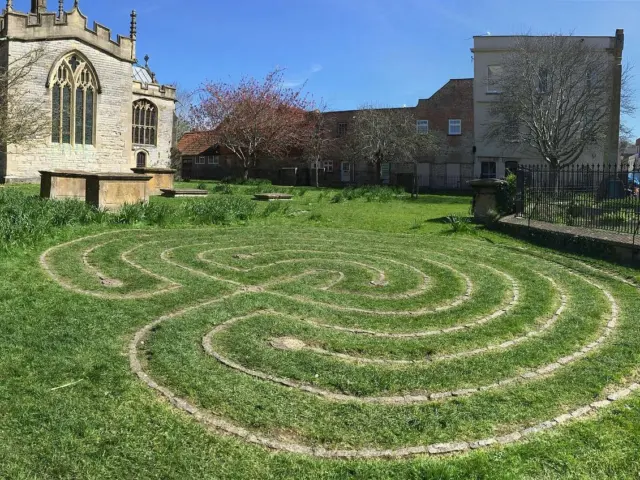
Seen side by side, the three examples are quite different places. One is a painted design in a town setting, one is a stone-edged path on retreat grounds, and one is a mown grass path that stays open through winter.
That variety is typical. A labyrinth can belong to a community group, a church, a conservation or education centre, or a retreat, and each owner decides who may walk it and when.
Walking time depends on the labyrinth’s dimensions, path length and your pace, not just its circuit count.
Neither type is better. They simply suit different moods, and many walkers like to try one of each.
Weather and season matter too. A path that feels calm in dry summer light can feel quite different under snow, so the same labyrinth can offer more than one kind of walk across the year.
What the listings tell you before you go
Those three entries show the details worth checking on any listing. Checking these details can help avoid a wasted trip.
- Availability: public, appointment or private.
- Situation and status: outdoor or indoor, permanent or portable.
- Type: classical 7-circuit, medieval 11-circuit and others.
- Wheelchair access: listed as yes or no, though the surface may still matter.
- Schedule and admission: always open, seasonal, or a daily fee.
Surface material also changes the walk. Painted concrete is firm and even, while grass or fieldstone paths can be soft, uneven or hidden by snow.
Walking a Canadian labyrinth in winter
Canadian winters shape how people use outdoor labyrinths. The Crieff Hills listing ties availability to snow levels, and the Canadian Ecology Centre listing mentions snowshoeing, so a snowy path may still be walkable if you dress for it.
Check the contact details on the listing if conditions look doubtful. Indoor and portable labyrinths, such as those in churches, offer an alternative when outdoor paths are buried.
Planning a trip around labyrinths
If you travel across provinces, the radius-based search is the quickest way to see what sits near your route. Enter a town or postal code, then widen the radius until a public site appears.
Before you set out, work through a short checklist:
- Open the listing and confirm the availability reads public.
- Check whether the site charges admission or asks you to call ahead.
- Look at the surface and the wheelchair field, and match them to your footwear and mobility.
- In snow season, read the schedule notes and contact the site if the listing is vague.
- Note the contact name on the entry in case the gate or building is closed.
Retreat centres and churches are working places, so a call is polite even when the listing says public. A short message also tells you whether a service, class or private event is happening.
Listings can be years old. If a phone number no longer works or a website has gone, try the host organisation, such as the church, town or centre named in the entry.
Making the most of a visit
Once you arrive, the walk itself is simple: follow the path in, pause at the centre, and walk back out at your own pace. Our guide to labyrinth walking covers how people approach it.
If no public labyrinth is near you, a tabletop version can stand in. You can trace one with a finger labyrinth printable at home.
Treat each site as someone’s shared space. Stay on the path, keep voices low, and leave the stones and markings as you found them.
Frequently asked questions
Are labyrinths in Canada free to walk?
Show answer
Many are, but not all. The Crieff Hills Retreat Centre listing shows admission of $10/day, so check each entry for fees.
Can I walk a labyrinth in winter?
Show answer
Sometimes. The Canadian Ecology Centre listing says its labyrinth is open 365 days, while Crieff Hills depends on snow levels.
What is the difference between a 7-circuit and an 11-circuit labyrinth?
Show answer
They are different designs. The Canadian Ecology Centre and Crieff Hills are listed as Classical 7-circuit, and Chemainus is listed as Medieval 11-circuit.
Do I need to book a visit?
Show answer
Check each listing’s access requirements; a public designation alone does not establish whether advance arrangements are needed. Appointment and private entries need permission from the host before you arrive, and it is courteous to check the contact details first even for public sites.
Is this site connected to the Labyrinth Locator?
Show answer
No. This is an independent educational site, and it is not affiliated with the directory or any site named here.