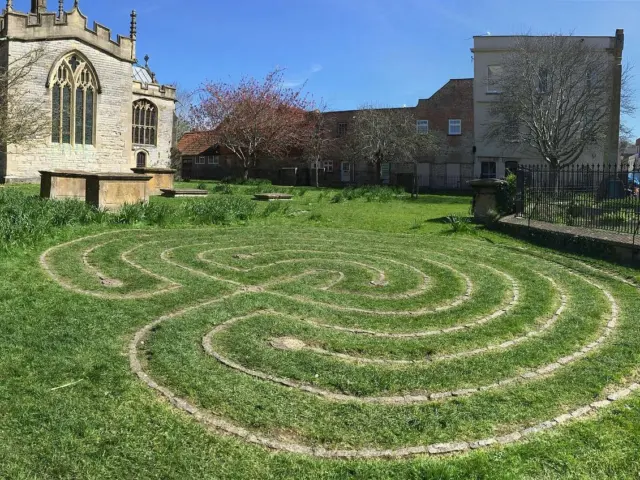

Feeling scattered and wanting a small pause? A finger labyrinth lets you trace a winding path with one fingertip, offering a simple focus for a quiet pause.
It is a small, portable cousin of the full-size labyrinth you can walk.
| Item | Detail |
|---|---|
| Finger to use | Index finger, placed at the entrance |
| Starting point | The entrance, then trace slowly toward the center |
| Breath in (Veriditas finger-walk exercise) | About 3 seconds of tracing |
| Breath out (Veriditas finger-walk exercise) | About 5 seconds of tracing |
| Path type | Single meandering path to a center |
Figures come from Healio and a Veriditas handout, and guidance can change, so check the sources before you rely on them.
What a finger labyrinth is
A finger labyrinth is a small labyrinth you trace by hand instead of walking. One guide explains that the user traces the path to the center using a finger rather than the feet, as described on a finger labyrinth explainer.
The Healio column mentions paper and wooden versions, and you can also find them in other materials such as cloth or clay. Like a full-size labyrinth, they follow a single winding route, so there are no dead ends.
That single path is the point. Your mind does not have to solve anything, so it can settle on the movement of your finger.
Labyrinth or maze?
The two look alike but work differently. The Healio column quotes nursing researchers who say that unlike a maze, a labyrinth consists of a single meandering path leading to a center.
A maze asks you to choose, guess and backtrack. A labyrinth asks only that you keep going, which is why it suits a tired or restless mind.
- A maze: many choices, dead ends, a puzzle to solve.
- A labyrinth: one route in, the same route out, nothing to decide.
What focus looks like on the path
Focus here is gentle. You are not forcing your mind to be empty, only returning again and again to one simple job: following the line with your fingertip.
Thoughts will still arrive, such as a to-do list or a worry from earlier. When one does, notice it, then bring your attention back to the path under your finger.
That small act of coming back is the practice. Each return is a repetition, and nothing about a wandering mind means you did it wrong.
Why people use one for calm
A Healio column from September 2026 says that tracing a paper or wooden labyrinth with a finger may be a useful stress reduction tool in waiting areas, offices or at home. The wording is cautious, and it is the author’s view rather than proof of a guaranteed effect.
The same column says finger labyrinths provide tactile engagement and may be used in meditation, stress reduction and mindfulness practices. Touch gives your attention something steady to rest on.
Treat it as a gentle practice, not a treatment. If anxiety is heavy or lasting, a finger labyrinth is no substitute for support from a health professional.
How to trace one, step by step
Guides agree on the basics. This version draws on the explainer and the Healio column.
- Sit comfortably and take deep breaths, then focus on the entrance of the labyrinth.
- Place your index finger at the entrance.
- Slowly trace the line or groove toward the center, letting extra thoughts fall away.
- Rest at the center for a moment and notice how you feel.
- Retrace the same path out, then sit back and breathe.
The explainer words the tracing step as: slowly trace the pattern of the labyrinth with your finger, allowing your mind to clear from extra thought. If your attention wanders, return to the touch of your fingertip on the path.

Adding breath to the tracing
A Veriditas resource guide for a virtual finger walk, written for World Labyrinth Day in 2020, uses a simple circle exercise. You place a finger at the bottom of a circle and trace clockwise as you breathe.
- Breathing in, trace one-third of the way around, which takes about 3 seconds.
- Breathing out, trace the remaining two-thirds to complete the circle, about 5 seconds.
You can borrow the idea on any labyrinth by letting each breath set the speed of your finger. If the timing feels forced, drop the counting and simply go slower than feels natural.
Making your own
You do not need to buy anything. A blogger who made a finger labyrinth when snow covered her outdoor one used a 12X12″ canvas, a printed design, heavy string and glue, following the seven-path Chartres design, as she explains on her blog.
She found that making a labyrinth was almost as good as walking one. A printed pattern on plain paper, traced with a fingertip, works as a quick stand-in.
When you are ready for the full-size version, read about labyrinth walking. For the walking steps, see how to walk a labyrinth.
When a finger labyrinth fits your day
A finger labyrinth takes less space than a full-size one and can be used indoors. Healio suggests waiting areas, offices and homes as places to use one.
Think of the moments when your mind races but your body has to stay put. A long wait, a break between meetings or the last few minutes before bed all leave room for one slow pass.
- Before a demanding task, to settle your attention.
- After a tense conversation, to let your breathing slow.
- During a quiet break, as a screen-free pause.
- At the end of the day, as a calm marker that work is finished.
None of these uses is a promise of a result. They are simple ways to give yourself a few unhurried minutes, and you can judge for yourself whether they help.
Making it a habit
Keep your finger labyrinth where you will see it, such as a desk, bedside table or waiting room. A few slow passes before a task or after a stressful call is enough.
- Sit comfortably and breathe before you start.
- Go at your own pace, with no goal of finishing fast.
- Pause at the center and notice how you feel before you trace back out.
There is no right amount of time. Some people trace once and move on, while others repeat the path several times.
Choosing a design
Pick a labyrinth that feels easy to follow. A simple pattern lets you relax into the motion, while a more intricate one asks for more attention.
Texture matters too, since the Healio column speaks of tracing a line or groove. A carved groove guides your fingertip, while a printed line lets you move more freely.
Try more than one if you can. The best one is the one you will actually reach for.
Frequently asked questions
Which finger should I use?
Show answer
The Healio column suggests the index finger placed at the entrance. Any comfortable finger is fine if that feels awkward.
Do I trace back out?
Show answer
Yes. The explainer says to rest at the center and then retrace your path out of the labyrinth.
Does it work for everyone?
Show answer
Not necessarily. The sources describe it as something that may help with stress, so notice what works for you.
Can I make one at home?
Show answer
Yes. A canvas or wood board, a printed design and heavy string glued along the lines make a tactile version.