Wondering about labyrinth vs maze? You are not alone. A labyrinth has a single winding path to the centre, while a maze has choices and dead ends.
The labyrinth is the heart of this site, and this page explains how it differs from its puzzling cousin.
| Feature | Detail |
|---|---|
| Labyrinth path | One path from entrance to centre |
| Maze path | Several paths, most ending in dead ends |
| Oldest surviving hedge maze (Hampton Court) | Planted in 1690 |
| Hampton Court path length | Half a mile of paths |
| Labyrinths and mazes in the UK | Around five hundred |
Figures come from Country Life (published 18 March 2023) and Jeff Saward’s Maze and Labyrinth Typology. They can change, so check the source before you rely on them.
The short answer: one path or many
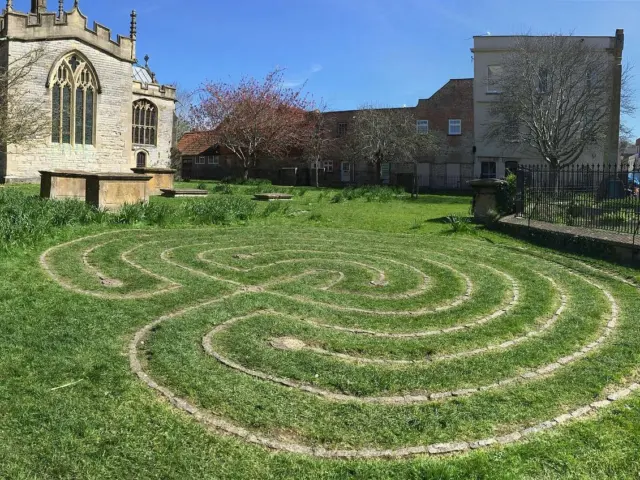
To the purist, a labyrinth is unicursal: it has just one path that leads you from the entrance to the centre, however winding its passages are. You cannot get lost, because there is nowhere to take a wrong turn.
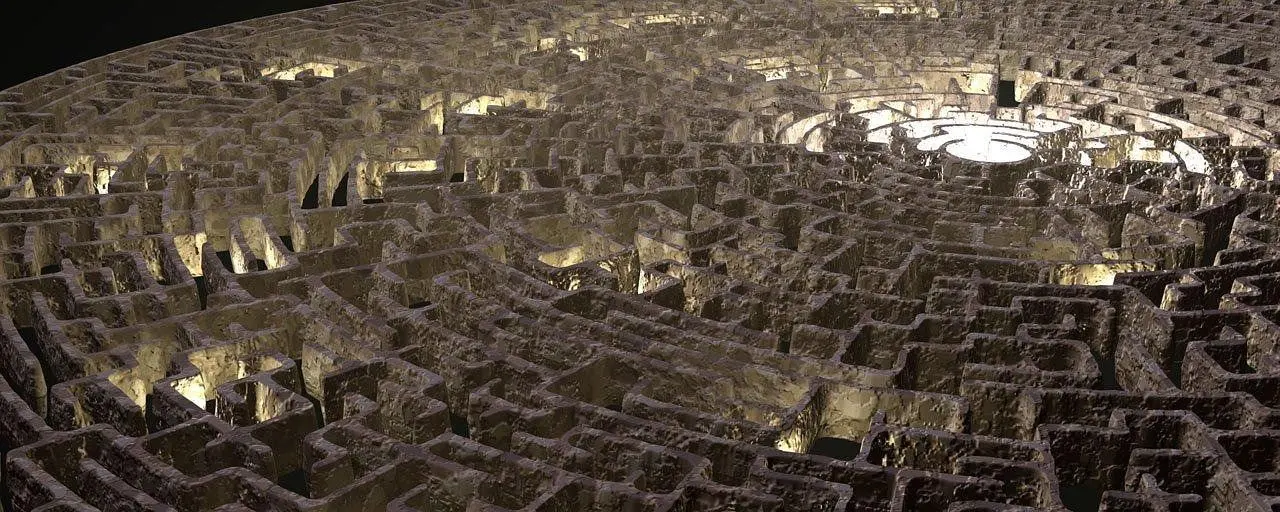
A maze is multicursal. It has several paths, most of which lead to dead ends, and usually only one takes you to the centre.
That single difference changes everything else about the experience. In a maze you make decisions, backtrack and solve a puzzle. In a labyrinth you simply keep walking.
Side-by-side comparison
| Question | Labyrinth | Maze |
|---|---|---|
| Number of routes | One continuous path | Many branching paths |
| Dead ends | None | Several, by design |
| Can you get lost? | No | Yes, that is the point |
| Main purpose | Contemplation, walking meditation, ritual | Puzzle, play, entertainment |
| Mental mode | Receptive, slow | Analytical, problem-solving |
This comparison draws on Country Life and the typology, so check them before relying on the details. Country Life sums up the contrast neatly: mazes test the explorer’s ability to solve problems, while a labyrinth lends itself to a slow, contemplative meander.
Why the difference matters when you walk
Because a labyrinth has no decisions, your mind is free to settle. Many people use that freedom for reflection, prayer or simply a calm few minutes.
A maze keeps the thinking part of your brain busy. That suits a fun afternoon with friends, but it works against quiet.
- Labyrinth: follow the path in, pause at the centre, return the same way.
- Maze: choose, test, hit a dead end, try again.
If you want practical steps for a calm walk, read our guide on how to walk a labyrinth.

Where the two words came from
The old story of the Minotaur describes a building you could not escape, and the word labyrinth was attached to it. Pliny the Elder, in his Naturalis historia, warned readers not to compare the Egyptian labyrinth with the mazes formed in the fields for the entertainment of children.
So even in ancient times, people sensed a difference between grand, serious labyrinths and playful mazes. For the symbolism behind the older designs, see our page on labyrinth meaning.
Country Life reports that the word maze comes from the Middle English “maes”, meaning delirium or delusion, and probably emerged to help distinguish multicursal designs from unicursal ones. Treat that etymology as likely rather than certain, since the source itself says “probably”.
Hedge mazes and the rise of the puzzle
Puzzle hedge mazes, with their multicursal paths, dead ends and hedges taller than eye level, were introduced in the late 17th century, according to Country Life. The oldest surviving example is at Hampton Court, planted for William of Orange in 1690 using hornbeam.
Saward’s typology adds that the earliest mazes in European gardens and palaces were made by rearranging the walls of a labyrinth to create a pathway with choices, often including a number of dead ends. In other words, the maze began as a labyrinth that was deliberately scrambled.
Today the multicursal category covers many modern installations in entertainment parks and tourist attractions, which exist solely to perplex visitors.
Choosing the right one for your day
The better choice depends on what you want from the time you spend walking. Neither is superior; they simply do different jobs.
Pick a labyrinth when you want to slow down. Pick a maze when you want a challenge, a laugh or a game to share with children.
- Feeling stressed or scattered: a labyrinth gives your attention a simple task, which is to keep stepping forward.
- Visiting with a group of friends or family: a hedge maze adds friendly competition and a bit of mild confusion.
- Looking for a place to think through a decision: the steady, unbranching rhythm of a labyrinth leaves room for thought without the pressure of choosing a route.
- Walking with young children: either can work, but a unicursal labyrinth avoids branching route choices.
It also helps to know what to expect on arrival. A labyrinth often looks calm and open, with the path marked in stone, grass, paint or mown turf, while a maze usually has walls or hedges that hide the way ahead.
Common mix-ups to avoid
The first mix-up is thinking a labyrinth must be simple. A labyrinth can be long and intricate, with many turns, and still have only one path.
The second is assuming a winding path means a maze. Winding is not the test; choice is. If every turn is forced, you are walking a labyrinth.
The third is believing the centre is the only point. Many walkers find the return journey just as meaningful as the way in, because the same path carries you back out.
Finally, remember that signs at public sites may use the words loosely. A park may advertise a maze that is really a labyrinth, or the reverse, so look at the layout instead of the label.
Edge cases and everyday usage
In ordinary speech the two words are often swapped, and a dictionary may treat them as the same thing. The strict split is a convention that enthusiasts, walkers and designers choose to keep.
The typology also notes a design can be technically multicursal yet still be a labyrinth by intent. Purpose counts alongside path layout.
A quick test you can use:
- Look at the layout: is there one route or a choice of routes?
- Ask what it is for: quiet walking or puzzle-solving?
- Check for branching choices: a single continuous route is the usual defining feature of a labyrinth.
Country Life notes that the distinction is a sensitive subject for people who care about it, so expect friendly disagreement if you raise it at a labyrinth event.
Frequently asked questions
Is a labyrinth the same as a maze?
Show answer
Not for purists. A labyrinth has one path to the centre, while a maze has several paths, most leading to dead ends. In casual speech, people often use the words interchangeably.
Can you get lost in a labyrinth?
Show answer
No. A unicursal design has just one path from entrance to centre, so you only need to keep walking.
What does unicursal mean?
Show answer
It means having a single path. Its opposite, multicursal, means having several paths with choices and dead ends.
Which is older, the labyrinth or the maze?
Show answer
Unicursal designs have been known as labyrinths for thousands of years, according to Saward’s typology. Puzzle mazes have a history stretching back to the late Middle Ages.