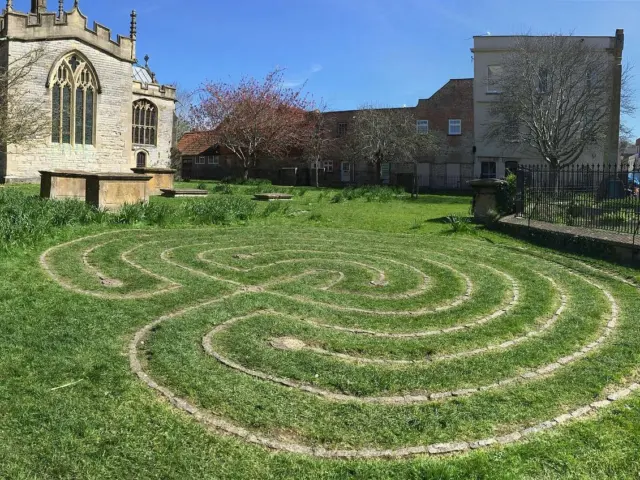
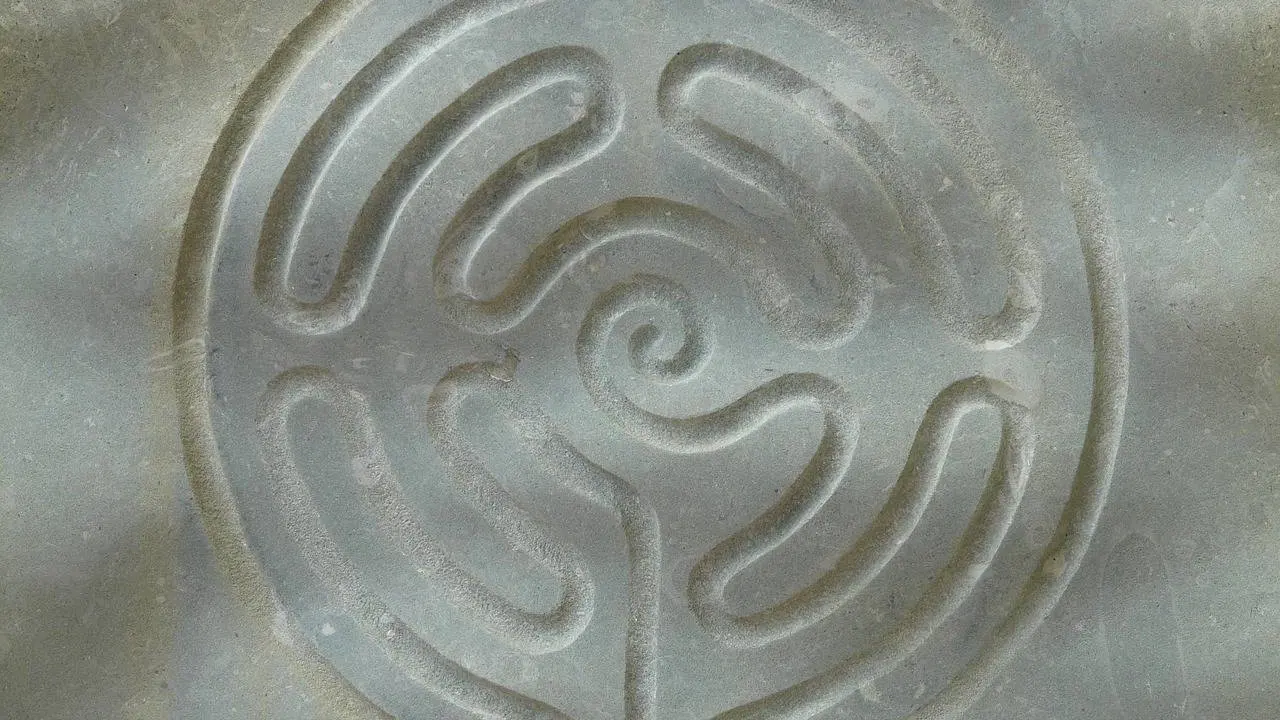
Wondering about the labyrinth meaning behind that spiral path? A labyrinth is a single winding path that leads to a centre and back, and it symbolises a journey, a search and a return.
This page is part of our guide to the labyrinth, and it looks at what the symbol has stood for.
| Item | Key fact |
|---|---|
| Origin of the word | Lydian, most likely reaching Crete from Anatolia through trade |
| Mythical designer | Daedalus, for King Minos of Knossos |
| Yearly tribute in the myth | Seven young men and seven maidens (14 young people) |
| Medieval nickname for church labyrinths | “The path to Jerusalem” |
| Earliest images of meditative walking | Eighteenth and nineteenth century |
The figures come from World History Encyclopedia and Medievalists.net. Retellings of myth and history vary, so check those sources before you rely on any detail.
Where the word and the symbol come from
The word is old and its roots are debated. World History Encyclopedia links it to the Minoan labrys, or double axe, but notes that the actual word is Lydian in origin.
That means the name probably travelled to Crete from Anatolia along trade routes. The meaning of the shape itself is much harder to pin down than the name.
What can be said safely is that the design shows up across cultures and eras. A winding path can be read as a story of departure and return.
The Minotaur myth: the labyrinth as a trial
The most famous labyrinth belongs to Greek mythology. In the story, Daedalus designed it for King Minos of Knossos to contain the Minotaur, a half-man, half-bull creature.
The same source says Athens had to send young people to Crete every year, and they were released into the labyrinth to be killed. Until Theseus vowed to end it, 14 young people were sent each cycle.
In this telling the labyrinth means:
- a place of danger and confinement;
- a test that a hero must face alone;
- a route that leads to one’s destiny, as World History Encyclopedia puts it.
Here the meaning is fear and courage. The centre holds a monster, and getting out means a story of cleverness and help from others.

The medieval church labyrinth: a path of pilgrimage
Later, labyrinths appeared in the floors of cathedrals. Medievalists.net says these designs became known as “the path to Jerusalem,” a symbol of pilgrimage.
The idea is that people who could not make the long journey to the holy city could travel it in spirit. The centre stands for the goal, and the walk back out stands for returning to ordinary life changed.
This reading is appealing, but historians urge caution. The same article states that there is no evidence these meditative walks happened before the eighteenth and nineteenth century images that show them.
So the pilgrimage meaning is best treated as a long-standing tradition of interpretation, not a proven medieval instruction. That honesty matters if you want to understand the symbol rather than only admire it.
Labyrinth meaning as a spiritual and personal path
World History Encyclopedia quotes the scholars Alwyn and Brinley Rees on why such designs resonated with ancient peoples, including the Celts. They write of the ritual significance of mazes as protection against supernatural powers and as a path the dead must follow.
The same page suggests the design may have helped a person find a spiritual path by removing them from the usual idea of linear time and direction. In that sense the labyrinth is a place between: you move, yet you are not heading in any one compass direction.
Many people today take from this a simple set of meanings:
- Journey: life as a winding path rather than a straight line;
- Trust: the path leads somewhere even when it seems to turn away from the centre;
- Return: arriving at the middle is only half the walk;
- Presence: slowing down, one step at a time.
These are modern readings, and they are valid as personal reflection. They are not a single official meaning, because none exists.
How to read the symbol for yourself
Because no single meaning is fixed, the most useful approach is to notice which reading fits your own situation. The same path can feel like a trial on a hard day and a comfort on a calm one.
Think about where you are in the story. Are you at the entrance, unsure whether to begin? Are you in the middle of the winding, where the path seems to take you away from the goal? Or are you coming back out, carrying what you found?
- Name the question you are carrying, even if it is only a mood or a worry.
- Picture the entrance as the moment you set that question down.
- Let the turns stand for the detours that real decisions often involve.
- Treat the centre as a pause, not a finish line.
- Notice how the walk back out feels different from the walk in.
None of this requires belief in any tradition. It is a way of borrowing an old shape to give your own thinking some structure.
It also helps to keep the history in proportion. The Greek story gives you the drama of danger and escape, the cathedral tradition gives you the idea of a sacred journey, and the scholars’ notes remind you that a path can take you out of ordinary time and direction.
These readings are not rivals so much as layers. A hero entering a monster’s lair, a pilgrim travelling to a holy place and a person seeking calm all share one pattern: leave the familiar, face the unknown, return changed.
That shared pattern probably explains why the symbol has lasted. Each age has laid its own concerns over the same simple path, from fear of the unknown to hope for a spiritual goal.
When you meet a labyrinth in a park, a garden or a church, you can therefore ask which layer the builders intended, and which layer you bring yourself. Both answers are part of its meaning, and only the first can be checked against evidence.
Common misunderstandings about labyrinth meaning
A few ideas circulate widely and are worth handling with care. Treating them as settled facts is the quickest way to mislead yourself or others.
- Claiming that medieval worshippers walked cathedral labyrinths for meditation. The evidence cited above only reaches back to later images.
- Assuming the word and the myth always belonged together. The word’s Lydian origin suggests a longer and more tangled history.
- Confusing a single-path walking labyrinth with a branching maze. A walking labyrinth has no route choices or dead ends.
- Expecting one correct spiritual message. Different traditions and different walkers find different things.
Keeping these distinctions clear lets you enjoy the symbol honestly. You can appreciate the tradition and still be clear about which parts are documented and which are interpretation.
Labyrinth or maze: does the meaning change?
Yes, a little. World History Encyclopedia says a labyrinth typically has a single path that winds through it, while a maze can have many paths. It adds that the two terms are often used interchangeably.
A maze asks you to make choices and risk dead ends, so it suggests puzzle and confusion. A labyrinth removes the choices, so it suggests surrender and trust. If you want the full comparison, read our piece on labyrinth vs maze.
That difference is why the labyrinth is used for quiet walking. You can learn how in our guide to labyrinth meditation.
Frequently asked questions
What is the simple meaning of a labyrinth?
Show answer
It is a winding path with one route to the centre and back out. It can be read as a symbol of a journey, a search or a spiritual path.
Does a labyrinth have one correct meaning?
Show answer
No. The Greek myth reads it as a trial, medieval tradition as a pilgrimage, and many modern walkers as a space for reflection.
Where does the word labyrinth come from?
Show answer
World History Encyclopedia says the word is Lydian in origin and probably came to Crete from Anatolia, though it is linked to the Minoan double axe, the labrys.
Was the church labyrinth really a substitute for going to Jerusalem?
Show answer
It became known as “the path to Jerusalem,” but Medievalists.net says there is no evidence of meditative walking on it before the eighteenth and nineteenth century images.